Gordon Prentice at Large - Politics in Newmarket





- Details
- Written by: Gordon Prentice
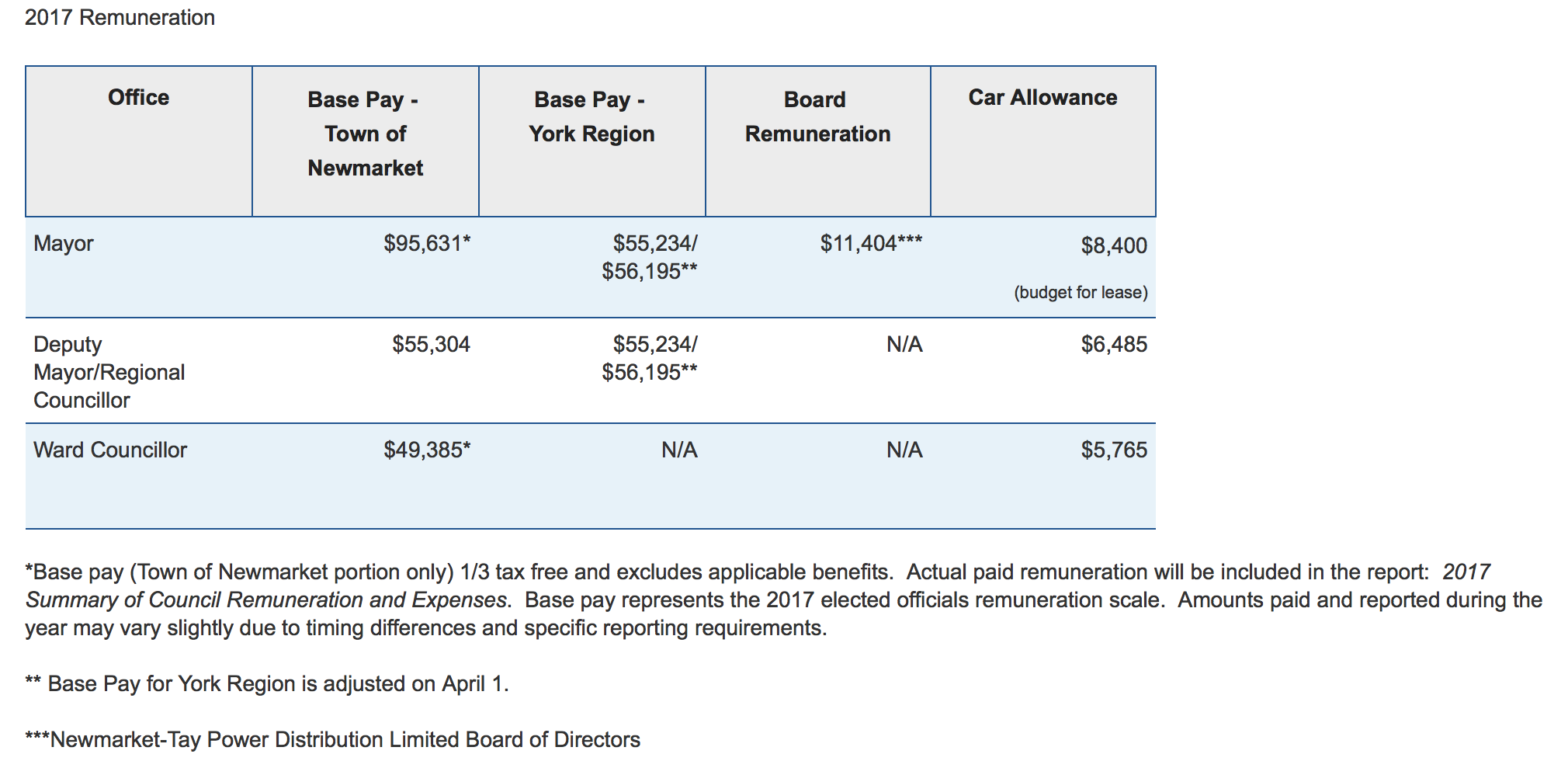
The Town of Newmarket has just released its Statement of Remuneration and Benefits for 2017. (It is dated 19 March 2018 but is just posted.). 
It shows Mayor Tony Van Trappist getting pay and benefits totalling over $212,000. You can read the details here.
He gets his cash from three main sources – the Town, York Region and Newmarket-Tay Hydro. He is on the latter two by virtue of his position as Mayor.
Apart from the cash that goes into the bank by way of his monthly salary he gets various benefits including his leased car. He claims for gas. His benefits include Omers, CPP, EHT and sundry group benefits.
The biggest distortion in the reporting of these figures lies in the Town salary which is one third tax-free. Some municipalities voted to get rid of this valuable concession but not Newmarket. This makes it impossible to compare the salary packages of Mayors and elected officials across the Province without knowing first if the Municipality is tax free or not.
Worse than useless
The figures for Van Trappist show that in its present form the Sunshine List is worse than useless.
Personally, I believe people should get the rate for the job and elected officials are no different from anyone else in this regard.
But I don’t like pretend salaries which massively understate the true value of the salary and benefits package available to people like Van Trappist.
The Federal Government has decided to abolish the one third tax-free concession for elected officials as from 2019.
- Details
- Written by: Gordon Prentice
"They call this the sunshine list, but for hard-working people of Ontario, there is nothing sunny about it. Liberals insiders and fat cats are getting raises while real folks in Ontario haven’t gotten a raise in years." #onpoli#PCPOLdr
Doug Ford
The CBC reports this morning (Saturday 24 March 2018) that the number of people on the City Hall payroll who joined the Sunshine list when Doug Ford was a Toronto councillor more than doubled. I burst out laughing! 
When I listen to Doug Ford I don’t know whether to laugh or cry.
A reporter asks if the $100,000 threshold should be raised as it is capturing more and more people, not just those on the very highest incomes. He side-steps the question saying it is not about the people getting $100,000 it’s about the millionaires and the fat cats. So why not lift the threshold?
We learn:
- The $100,000 salary threshold for disclosure has not changed since the legislation came into force in 1996 and there has been no uprating since for inflation.
- If the salary threshold were adjusted for inflation, it would be $151,929 in today's dollars, reducing the number of people on the list by 85%
- The $100,000 figure represents total pay — salary plus any bonuses or overtime — but not benefits. Taxable benefits are reported on a separate line.
Laughing all the way to the Bank
Now I'm looking at the figures for Newmarket Mayor, Tony Van Trappist, who appears in the Sunshine List with a salary of $120,393.14 plus taxable benefits of $7,656.20. Now I am gently chortling. If you believe that you believe in the tooth fairy.
Then the thought occurs... in fact, the old banker has been laughing at us for years!
Van Trappist's Newmarket salary comes one-third tax free so he declares $63,000 to the CRA rather than $95,000 and then adds the $56,000 he gets for sitting on York Regional Council and he gets his Sunshine salary of $120,000 (My figures are approximates. The Town has not yet formally released its remuneration report for 2017 - due by 31 March 2018.) 
The wily old banker excludes the $11,000 he gets for sitting on the Hydro Board (which comes with the job of Mayor) because he is not paid by the Town directly but by Newmarket-Tay Hydro. You've gotta laugh!
In his own defence, the old banker would say the Public Sector Disclosure Act only requires income to be reported as it is for Income Tax purposes - box 14 on a T4. So, no need to draw attention to the one-third tax free nor the little number from the Hydro!
The $56,000 from York Region is included in the Sunshine calculations because it paid by the Town and reimbursed by the Region. So why can't the old banker's $11,000 from the Hydro (excluded from the Sunshine calculations) be paid by the Town and be similarly reimbursed by the Hydro?
Van Trappist's 2017 salary plus benefits to be revealed next week
Van Trappist's true salary is $95,000 + $55,000 + $11,000 = $161,000 plus all the various allowances and benefits and bits and pieces.
That said, $161,000 is not a King's ransom these days. Half the police officers in Toronto probably get that. They are almost all on the Sunshine List.
Calculating how much the Mayor gets is not straightforward.
The real issue is whether we are getting value for our money.
That's the kind of thing Doug Ford would say.
LOL!
Update on 27 March 2018: Visit https://www.notdoug.com and keep up-to-date on what the great man is doing.
Note: During Ford's term as a Toronto city councillor and key adviser to his brother, late former mayor Rob Ford, the number of city employees on the Sunshine List jumped from 5,415 in 2010 to 11,282 in 2014.
- Details
- Written by: Gordon Prentice
The monster house at 1011 Elgin Street will feature as a case study for councillors looking at how best to manage infill development in stable residential neighbourhoods across Newmarket.
The Council Workshop will be held at 10am on Monday 26 March 2018 – a full year after it was first proposed by Ward 3 councillor Jane Twinney. It is open to the public. 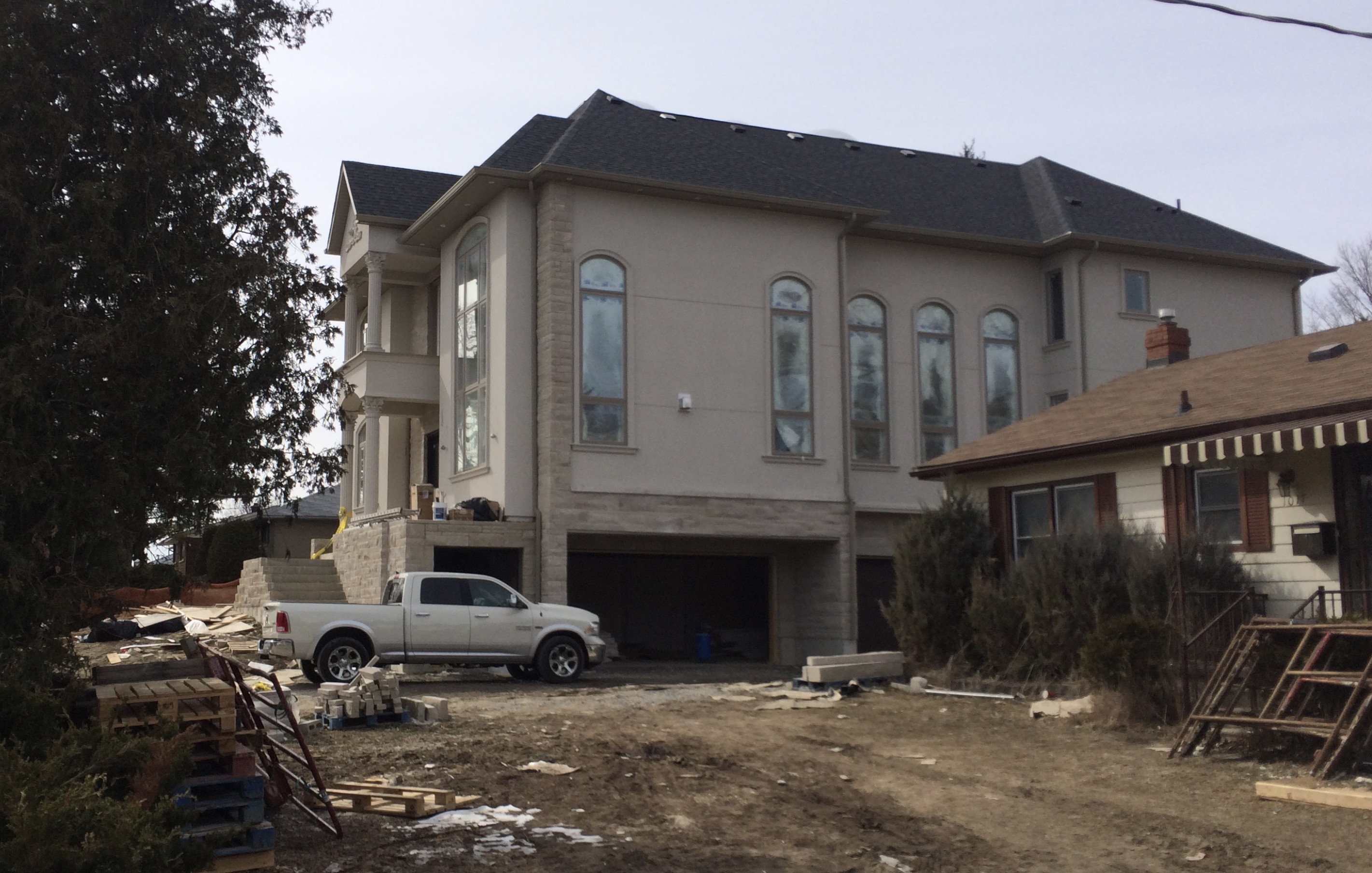
For the majority of our councillors and for the Town’s senior staff this infill issue is nothing new. On 19 September 2011 the Committee of the Whole asked staff to:
“investigate the matter of infill development and its compatibility in stable residential neighbourhoods…”
This led to the 6 March 2012 report on Intensification in Stable Residential Areas which can be found here.
Councillors should read this old report whose recommendations, for whatever reason, were apparently never acted upon. This observation from March 2012 still holds good today:
“The application of the current by-law for new detached or semi-detached dwellings works best in newer neighbourhoods where all the homes are of the same vintage and character and, as such, excessive variations in building mass, height and coverage would not likely occur. However, if a new dwelling that complies with By-law 2010-40 is situated in an older established neighbourhood, the perception for incompatibility of built form increases substantially resulting in a new home that could be considered contextually inappropriate in its neighbourhood.”
Lilliputian neighbours
1011 Elgin Street has been under construction since the summer of 2016. The house sits on raised ground, towering over its Lilliputian neighbours.
The Town did not consult the people living next door to 1011 Elgin Street giving them an opportunity to comment or make representations. The Town would say it isn’t obliged to. In fact, no-one was consulted because the monster house ostensibly meets the terms of the zoning by-law for that area of Town. The owner, Morad Dadgar, only required a building permit. If neighbours or anyone else thought it too big they would have to dig into their own pockets and pay for their own survey.
We are told it is less than the specified maximum height of 10.7m and it occupies less than 35% of the lot area (although the estimated % figure produced by the Town varies). 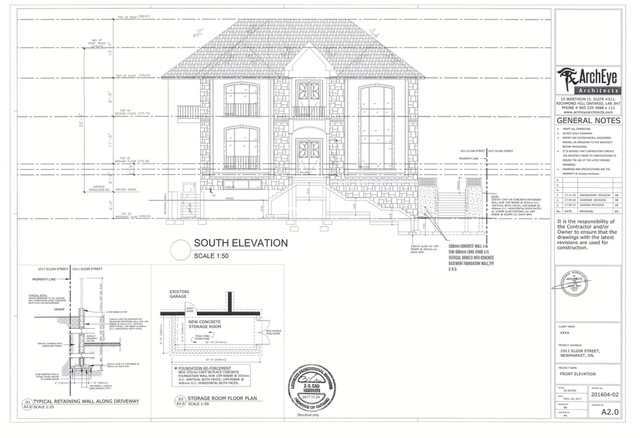
By my back of the envelope calculations the house is 46’ 4” (or 14.12m) high from the basement slab to the ridge of the roof. This is what is actually visible to the naked eye looking at the house from Leslie and that is not going to change. The height as shown on the developer’s drawings is 33’3” (or 10.13m) and measures the distance from the average grade (where the base of the house meets the ground) to the mid-point of the roof. Maybe I’ve got this all wrong. I don’t think so but I struggle with this stuff.
And how many ways are there of measuring height? Across the country, there seems to be no commonly accepted definition of “height”. Earth can be moved around, changing the grading, influencing the perceived height.
Good planning?
But even if the house satisfies the relevant zone standards does 1011 Elgin Street represent “good planning”?
If not, why not?
It contributes in its own way to the more intensive use of land which is a Provincial priority but is it “contextually inappropriate in its neighbourhood”?
It certainly towers over its neighbours.
In 2012 the Director of Planning, Rick Nethery, floated the possibility of a height policy stipulating that
“a maximum proposed building height may not exceed the height of the highest points of the rooflines of existing residential buildings on immediately adjoining properties sharing lot lines with the lands subject to new development.”
In 2012 councillors were told:
“Regulating lot coverage is an excellent way to prevent overbuilding in low density residential areas. If it is determined that a particular area has an average lot coverage of 25% an approach could be to set the lot coverage for a 2 storey building at 25% and allow a greater amount of coverage for a bungalow at 35%. This would also encourage one storey buildings in established neighbourhoods.”
Councillors should imagine themselves living next door to the monster house at 1011 Elgin Street. The streetscape is transformed. Your privacy is gone as the windows in the new house overlook your formerly private garden.
The construction work has been going on for almost two years and it is not over yet.
Perhaps it is now time to go back to the future and reconsider the Director of Planning’s report from March 2012.
There were some good ideas back then.
Six years ago.
Read the October 2017 report on Intensification in Stable Residential Areas here.