Gordon Prentice at Large - Politics in Newmarket





- Details
- Written by: Gordon Prentice
This afternoon I wander down to the York Region Administrative HQ where I have been given the opportunity to address the two special advisers, Ken Seiling and Michael Fenn, who were appointed in January to review regional government in Ontario and to come up with recommendations. (Photo: the advisers in the centre of the hemicycle waiting for the kick-off.)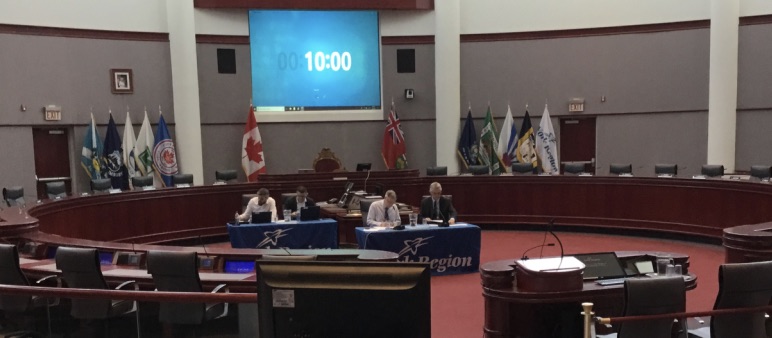
Astonishingly, there are only five of us down to speak. There’s CUPE, the Ontario Library Association, a delegation from the Unionville Residents’ Association in Markham, the Director of Markham Museums and me, a member of the public.
We are seeing consultation by stealth. No full page ads in the press. No email blasts. And only a few days to get your request in to speak. You blink an eyelid and you’ve missed it. Hmmm. Too bad!
3-5 minutes
In an email beforehand from the advisers’ back-up team I am told I have been given 3 – 5 minutes to make my case.
“When preparing your remarks to the advisers, please keep in mind that the advisers want to hear your views on the way your elected municipal representatives make their decisions and represent your community. The advisers also want your thoughts and observations on the efficiency, effectiveness and cost of the various municipal services that your municipalities provide. In particular, the advisors are looking for your feedback on regional governance; decision-making and service delivery.”
That’s a lot of ground to cover in three minutes.
As the CUPE person is standing at the lectern Michael Fenn says that because there are so few of us we now have ten minutes.
Zero information
I decide to concentrate my fire on three targets.
First, there has been next to no background information provided by the Province. I tell the advisers I have no sense of where they are coming from. Will the review recommend amalgamations?
The review asks if two tier structures are appropriate for all municipalities. But we have zero information on the costs of moving to a single tier. These are likely to be very substantial. I rely on reports from Mississauga (which wishes to secede from the Region of Peel):
“Studies done by various researchers and academics have concluded that amalgamations in Ontario and in other provinces have resulted in cost increases, not cost savings or service efficiencies.”
We have no evidence on the costs of previous amalgamations and their impact on service delivery.
Local means local
Second. I believe local government should be as local as possible. And I take it as axiomatic that citizen involvement is a good thing. So getting rid of the lower tier and uploading everything to the regional level wouldn’t be desirable. And it wouldn’t work. York is not a city region. It covers a huge area. I mention efficiencies arising from co-operation between the lower tier authorities.
Third. I move swiftly on to governance issues. Three years ago I gave evidence to the Bill Committee at Queen’s Park and argued for the direct election of the York Regional Chair. I was disappointed the Ford Government cancelled the 2018 election at the same time it was cutting Toronto City Council by half. I remind the advisers the then PC Opposition voted with the Liberal Government to have York Regional Chair elected by the voters at large.
Now I hear myself quoting from a chunk of my Queen’s Park speech. Why can Durham have an elected Chair but not York? (Photo right: Durham Regional Chairs debate 2018).
York has a population bigger than PEI, Newfoundland, Labrador, New Brunswick, Nova Scotia and Saskatchewan – and is closing on Manitoba. Yet the Chair is indirectly elected by 20 people. 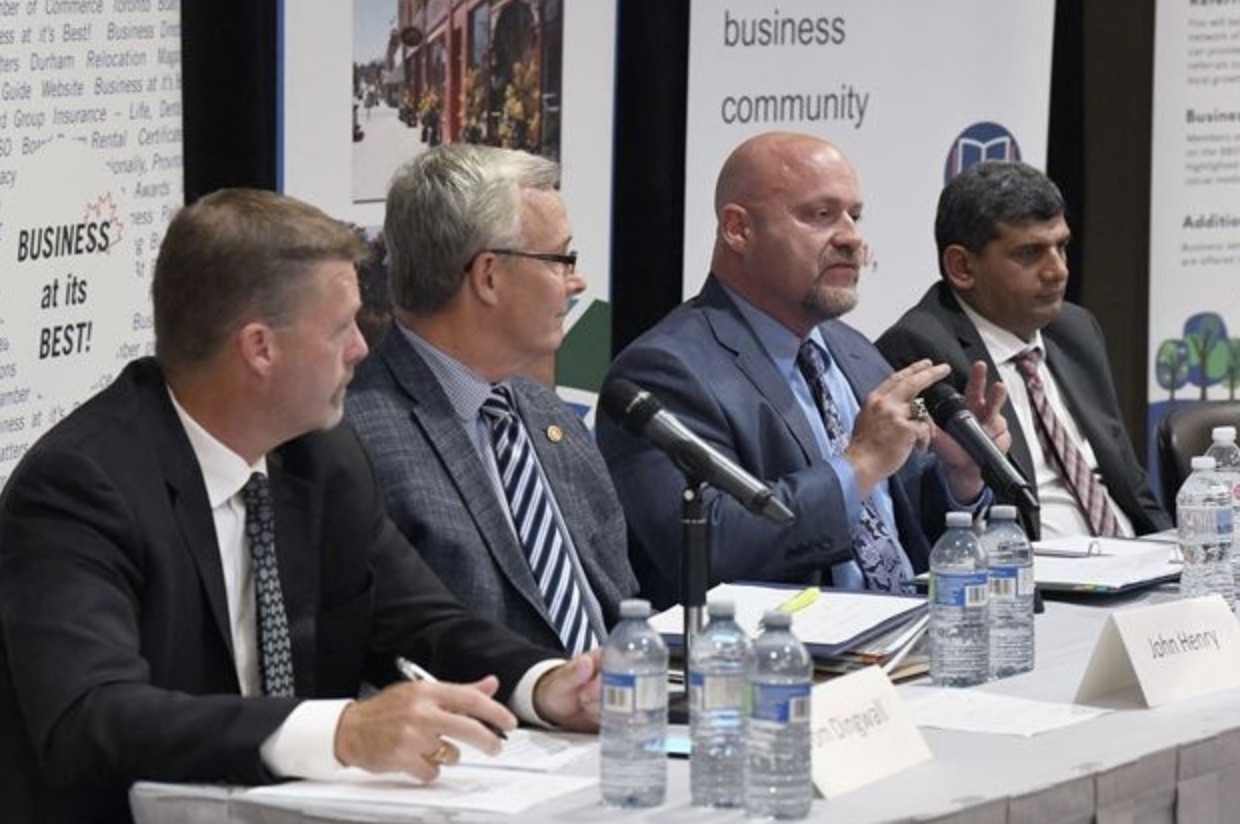
The invisible man
I tell the advisers I would be surprised if one in 1,000 people could name the regional chair, Wayne Emmerson. He is totally invisible to the general public.
Now I am well into my stride. I am on top of my soapbox talking about the importance of elections. They are about competing visions of the future and about deciding priorities. In the absence of elections these debates happen but in a muted way inside this hermetically sealed Chamber. Now I am galloping along.
There is no citizen involvement to speak of. And the method of election to York Region is also part of the problem. The system used is “Double Direct” and it doesn’t work. The review team has given the public no explanation of what it is and possible alternatives. (There is one election for double direct with Mayors and Regional Councillors sitting on two bodies – the lower tier municipality and the Region.)
Academics say that with double direct the upper tier is less accountable to the community and there are conflicts of interest with members trying simultaneously to represent the views and policy positions of the upper and lower tiers which may be different. I agree with that.
Mayors not pulling their weight
I tell the advisers I have spent years observing members of York Regional Council and many of them make next to no contribution at all. Mayors are passported on to the Region, picking up their $55,000 “stipend”. Some are disinclined to make any effort at all, focussing solely on their own patch. And regional report-backs to the lower tier can be very perfunctory.
Maybe that will change now that we have live streaming from the Regional Council Chamber, a recent innovation.
The solution is to take the Mayors out of the regional tier and have Regional Councillors focussed exclusively on regional priorities.
The advisers want to know how big my regional council will be. Answer: as big or as small as you want it to be.
I have 1:45 seconds left and decide to get something off my chest that has been bugging me for years. In Newmarket planning approvals for major developments were given to landowners ten and even twenty years ago but nothing has been built. We see a patch of dirt where the condo should be. We need sunset clauses to revoke planning approvals if they are not acted upon after, say, five years. I concede this is off-point but it chimes perfectly with the Ford Government’s announcement last week to get more housing built in shorter timeframes.
And that’s it. Time’s up. My suggestions will no doubt be filed away and be forgotten while Ford redraws the municipal map.
York Region will decide its response to the Regional Review on Thursday 9 May 2019 following the advice of a working group consisting solely of the Mayors of the nine constituent municipalities.
Members of the public have until May 21, to submit their views. 500 words of less, please!
Recommendations from the advisory body will focus on the following questions:
Questions on municipal governance and decision-making;
- Is the decision-making (mechanisms and priorities) of upper- and lower-tier municipalities efficiently aligned?
- Does the existing model support the capacity of the municipalities to make decisions efficiently?
- Are two-tier structures appropriate for all of these municipalities?
- Does the distribution of councillors represent the residents well?
- Do the ways that regional councillors/heads of council get elected/appointed to serve on regional council help to align lower- and upper-tier priorities?
Questions on municipal service delivery;
- Is there opportunity for more efficient allocation of various service responsibilities?
- Is there duplication of activities?
- Are there opportunities for cost savings?
- Are there barriers to making effective and responsive infrastructure and service delivery decisions?
Update on 14 May 2019: And this is how Newmarket Today covered the story.
- Details
- Written by: Gordon Prentice
The Superior Court in Newmarket has ordered Aurora businessman and PC activist Anthony Pullano to pay a whopping $174,400 in costs to Magna’s Steve Hinder on top of the $50,000 awarded by the jury last December in general damages for defamation.
Brock Weir quotes the trial judge in his recent piece in the Auroran. 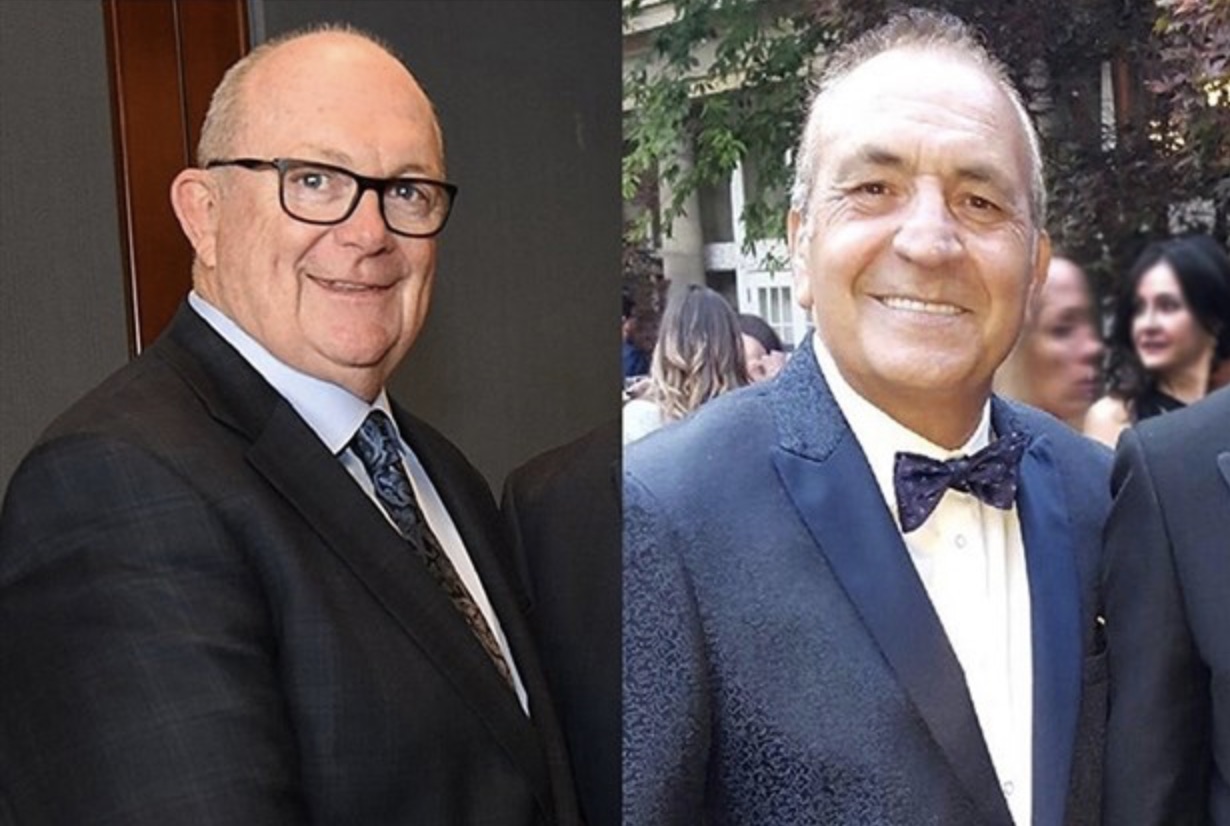
I sat through the trial and I found the judge to be, at times, impatient and irascible. He was often exasperated – and let it show.
Pullano his own worst enemy
And not without some cause. Anthony Pullano was his own worst enemy. He couldn’t answer a straight question. He was meandering and long-winded and very often off-point. But he had a story to tell and the jury delivered its verdict on the facts after being instructed on the law by Mr Justice McCarthy.
I am not a lawyer or a pretend lawyer. I am Joe Public. But the judge’s reasoning raises a few red flags for me. (Photo: Hinder of the left, Pullano on the right)
The judge said:
“The plaintiff was entirely unsuccessful at trial. The finding by the jury that he had been punched by Hinder, in all circumstances, cannot be viewed as constituting any measurable level of success. The jury dismissed the notion that Pullano sustained any physical, emotional or psychological injury. The jury rejected the suggestion that the punch had caused the infection of his [cardiac] implantation site. There was no basis for an award of general damages. I have found that an award of nominal charges is unwarranted.”
But Mr Justice McCarthy chose not to instruct the jury on the law of battery despite being asked to do so by Pullano’s sterling lawyer, William Reid. In fact, the judge sought and received the consent of counsel from both sides to abandon the charge of assault and substitute battery. In law, these have different meanings. The jury was left in the dark about the elements of the tort of battery. At the time I thought this was a big deal. I was asking myself how I would approach the issue had I been on the jury. The judge also misdirected the jury on the law on damages.
The judge goes on:
“The jury found no conduct on the part of Hinder deserving of aggravated or punitive damages. Conversely, the jury found multiple instances of defamation of Hinder by Pullano; implicit in its verdict is that it accepted Hinder’s evidence that he had suffered emotional upset and embarrassment as a result of Pullano’s defamatory comments being disseminated via social media to the broader community.”
The damning evidence of Fred Rankel
I heard things at the trial that the jury did not. If there was legal argument about the admissibility of evidence the jury was asked to leave but members of the public were allowed to stay and hear the exchanges.
The judge excluded important evidence from Fred Rankel, a successful Auroran businessman of many years standing who knew Hinder and Pullano but was beholden to neither. He told the Court under oath how Hinder described the former Mayor of Aurora, Phyllis Morris, in an uncouth and deeply offensive manner.
The judge stopped Reid’s line of questioning in its tracks and asked Fred Rankel and the jury to leave the Court while this was dealt with.
Reid said Hinder’s counter-claim for defamation meant his (Hinder’s) previous statements about people should be put before the jury to give them a rounded picture of the type of man that Steve Hinder is.
Reid told the Judge that on 10 June 2014 Hinder said to the former Mayor of Aurora, Tim Jones, in the presence of Mr Rankel:
“If these WOPs get elected we will have to roll up our tents and leave town.”
Pullano’s lawyer told the judge these and other similar statements by Hinder were crucial to the defence and to rebutting the counter-claim on defamation. The judge disagreed and ruled such statements would be severely prejudicial to Hinder and he would not allow them to be put before the jury.
We are told Anthony Pullano has until 15 May to decide on an appeal. I do not envy William Reid who must advise his client on whether or not to go down that perilous road.
Pullano has already been taken to the cleaners financially and the thought of him forking out even more money for what may be a lost cause makes me shudder.
You can read Mr Justice McCarthy’s decision on costs here.
Update on 10 May 2019: Anthony Pullano has confirmed his lawyer has filed a Notice of Appeal
- Details
- Written by: Gordon Prentice
The constituency office of Newmarket-Aurora’s MPP, Christine Elliott, was today picketed by a good-natured rainbow coalition of protesters, all concerned about Doug Ford’s latest cuts.
The group says they are independent and not party political.
I see familiar smiley faces. Not one of them looks threatening.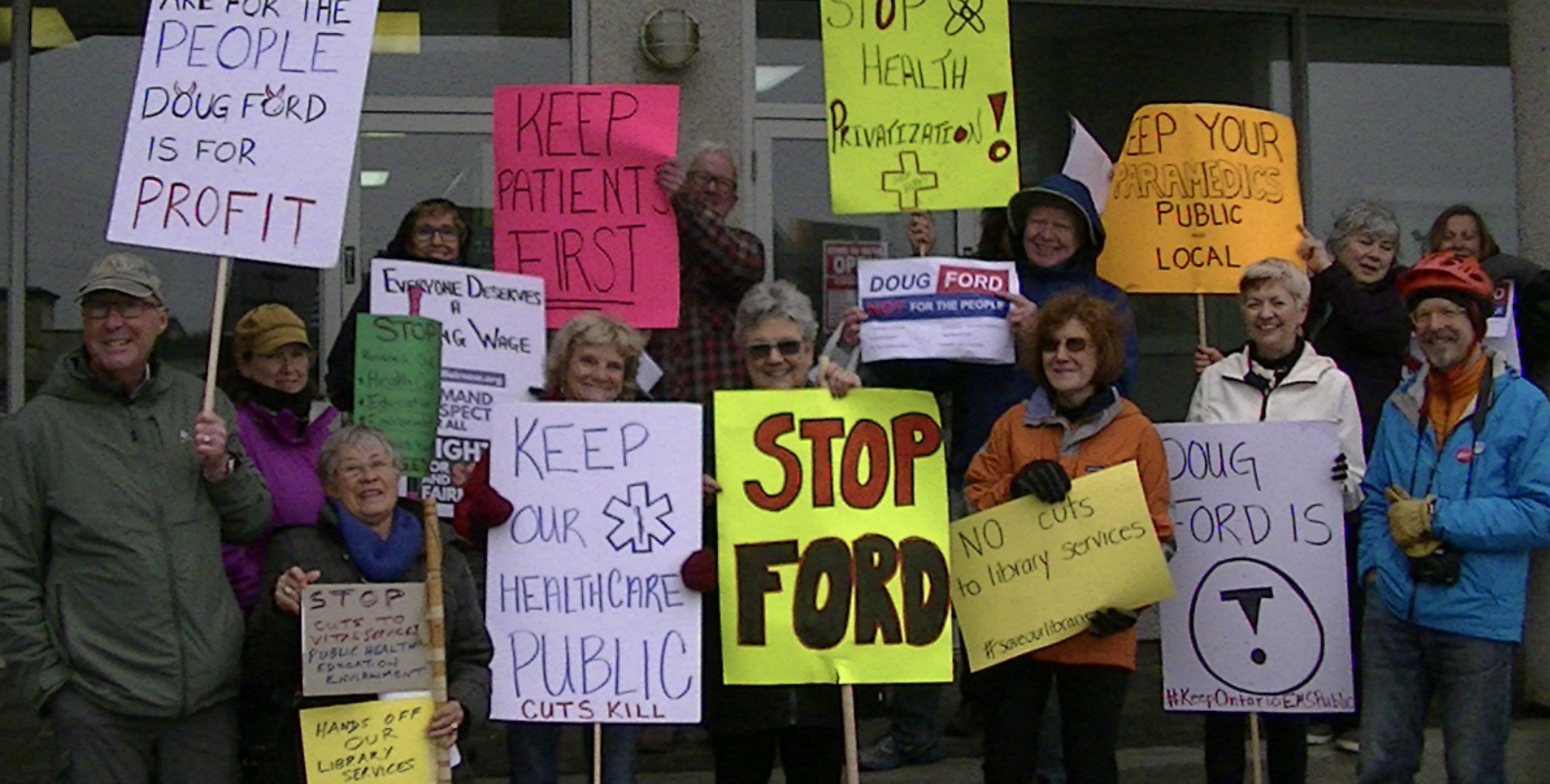
Jackie Playter is in the thick of it, holding a placard aloft which shouts:
“Keep our Healthcare Public. Cuts Kill.”
Jackie, Newmarket's Honorary Citizen of 2017 and the Town's champion hugger, vows to be back outside Elliott’s office next Wednesday from 12 noon to 1pm doing the same thing.
Protesting. Gently.
Elliott’s staff lock the front door, keeping the protesters at bay, while insisting:
“There are no cuts.”
Elliott is, of course, Minister of Health besides being Ford's Deputy Leader - even though she can't stand him.
In its review of the 2019 Ontario Budget, the Conference Board of Canada, says
“The province plans to restrict growth in health care spending to 1.8 per cent over the next five years. This will be a remarkable feat if achieved, as the province has seen health care spending grow at an average annual rate of 3.7 per cent over the last decade.”
This means reining back health spending significantly while Elliott and Ford place their faith in “efficiencies”.
The Toronto Star’s Robert Benzie tells us:
“Queen’s Park is slashing its share of public health funding with municipalities from 75 per cent to 50 per cent, and eliminating thousands of teachers’ positions across the province.” 
We are told spending cuts extend from trees to libraries.
Ford likes cutting programs by half
At a time of unprecedented flooding Ford is cutting in half the provincial funding to Ontario’s 36 conservation authorities.
The Ontario library service is losing half of their provincial funding, axing inter-library loans which will be a hammer blow to more isolated communities.
But, funnily enough, there always seems to be enough money to pay inflated salaries to Ford’s cronies who land plum patronage jobs in and around government.
Here is the Toronto Star's list of winners and losers in Ford's first budget.
If you need an alcoholic drink at 9am then Doug Ford is your man.
Background: Elliott was parachuted into the riding after Charity McGrath was blocked by Ford from standing as PC candidate for election irregularities. Elliott hates Ford but conceals her animus towards him as the price of remaining PC Deputy Leader and Minister of Health. Elliott chooses not live in the riding.
Update on 9 May 2019: This is how Newmarket Today covered the story as it developed.