Gordon Prentice at Large - Politics in Newmarket


- Details
- Written by: Gordon Prentice
Bob Kwapis election signs are all over Ward 5. No other candidate comes close to matching him. 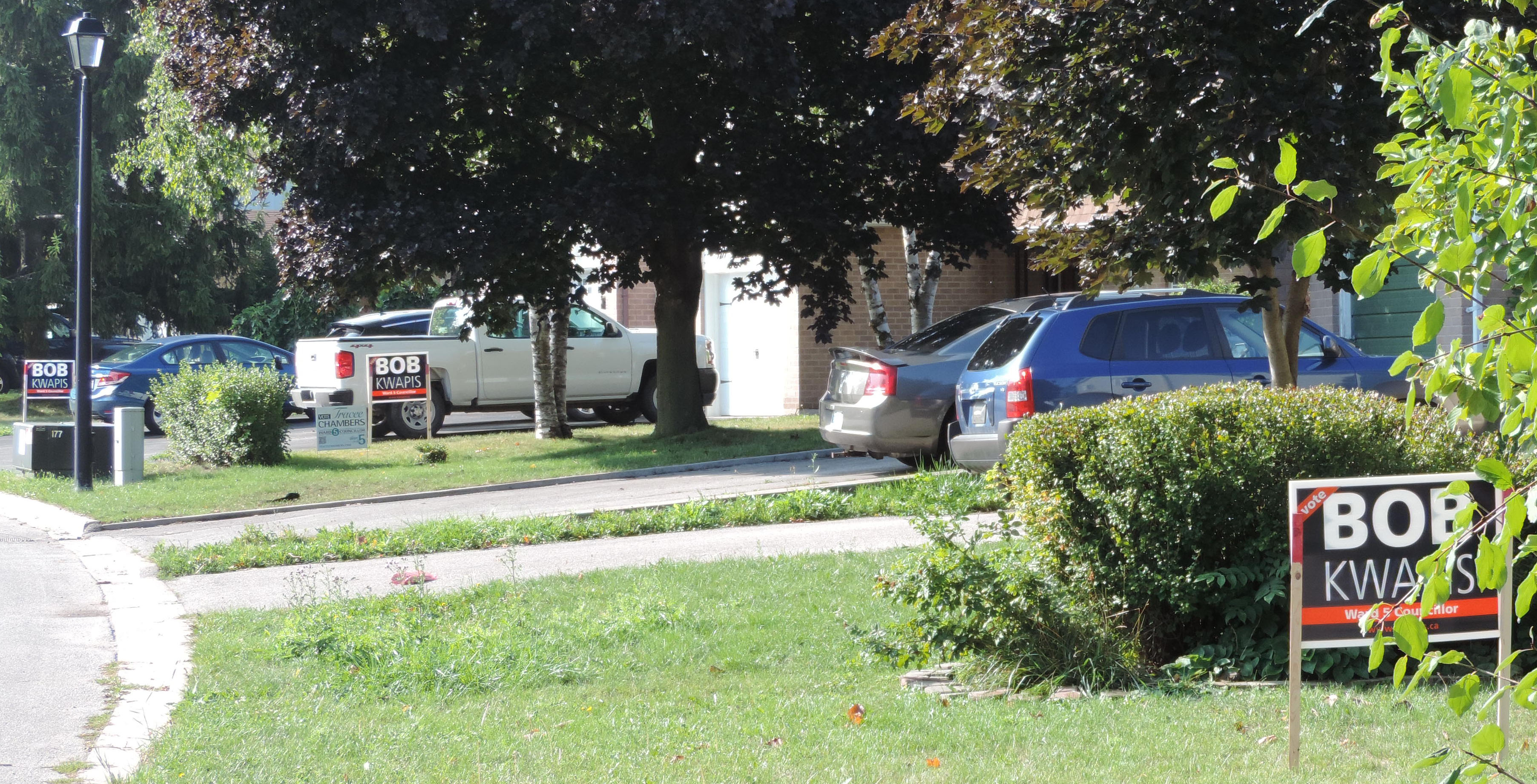
It gets me thinking. How effective are election signs in the age of social media? Do they make a difference? (See below)
I had a hunch something spectacular was going to happen. When my wife and I were driving home from the Aurora Hoedown late on Friday evening we saw Kwapis’ young muscular team driving wooden stakes into the ground with a sledgehammer. No dainty election signs for Kwapis. You know, the ones with wires you effortlessly sink into the lawn – the type used by Darryl Wolk and Tracee Chambers.
No. The Kwapis signs are big and bold and can’t be uprooted or blown over by a gentle breeze. They sprang up overnight like mushrooms.
On Saturday, they were absolutely everywhere. Clearly, Kwapis has extensive lists of supporters through his Progressive Conservative contacts and, presumably, from his work on traffic safety issues in Ward 5.
Sandford Street likes Bob Kwapis
Sandford Street – probably a rat-run from Eagle to Mulock – had a Kwapis sign on every second lawn. The one Wasim Jarrah sign I spotted was also on Sandford. It was the same size and dark blue colour as Kwapis and could easily have been overlooked. (Whatever happened to the purple signs at Wasim’s launch at the Hungry Brew Hops?) 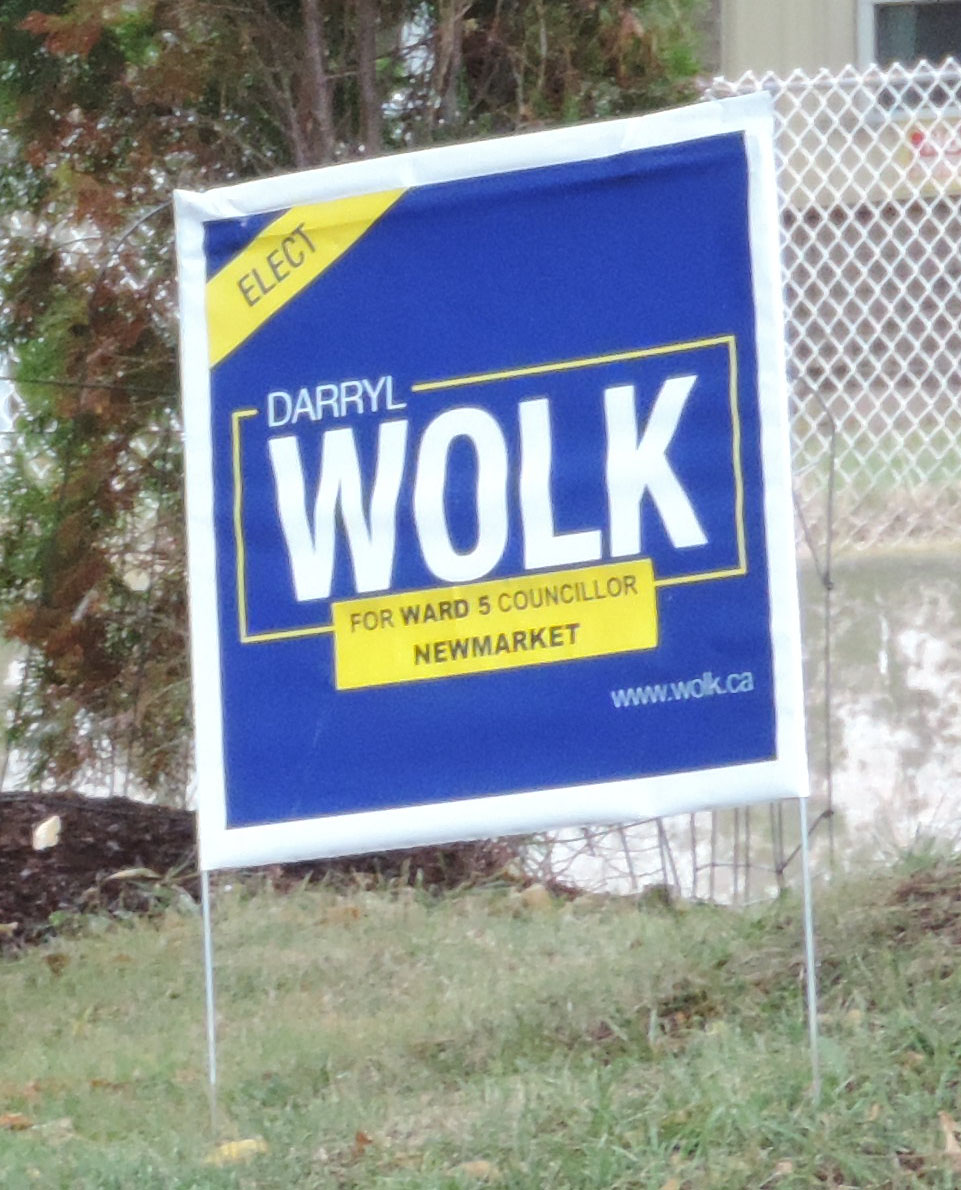
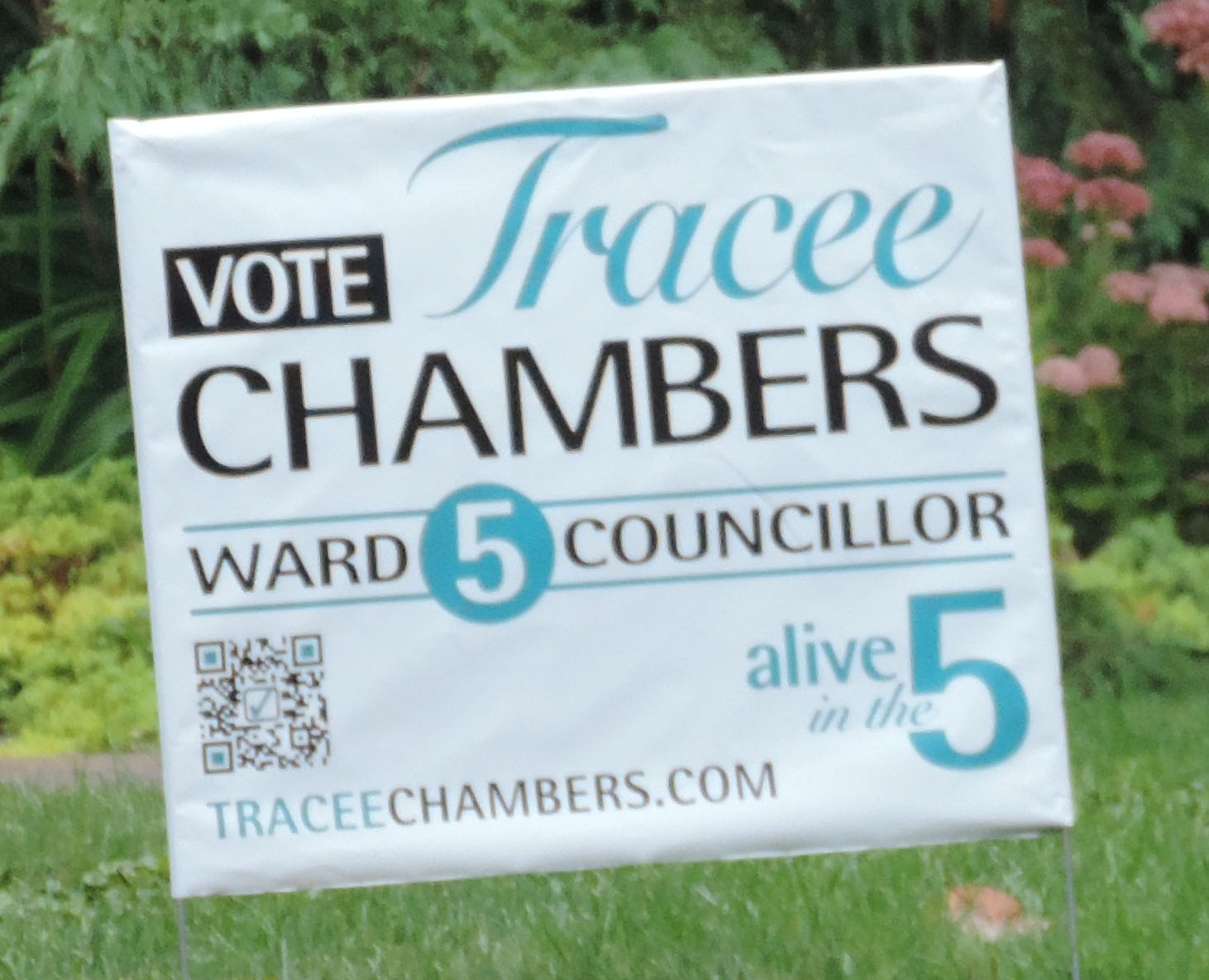
So, do election signs make a difference? Some recent research from academics in the US suggests they matter only at the margins. Certainly, lawn signs show who is in the race. If some candidates can’t get a single lawn sign up then, I suspect, they are facing Armageddon at the polls. Tracee Chambers and Darryl Wolk both have a fair sprinkling of lawn signs but must do better.
 York University politics professor, Robert MacDermid, says:
“Even in supposedly low-cost municipal elections, a small amount of money may give a candidate publicity and profile. Where voters often know next to nothing about what a candidate stands for, election signs and a campaign brochure may suggest that one candidate is credible while another, who lacks financial support, “must” represent fringe views.”
Lawn signs, he says, leave an impression of popular support.
There are, of course, no opinion polls in municipal by-elections, so signs are one, crude, measure of support. But not everyone in a household necessarily agrees with the message planted on the lawn. And people risk upsetting their neighbours by putting up a sign. But, here in Ward 5, I suspect putting up a Kwapis sign may be a cry for help. Kwapis is selling himself as the candidate who can solve the Ward’s traffic problems – and who wouldn’t support that?
The whole Town has traffic problems
I have traffic problems where I live. In fact, the entire Town has traffic problems. If I could vote for someone who could make our traffic problems vanish overnight I guess I’d back them.
Traffic though, while important, is a second order issue in this by-election.
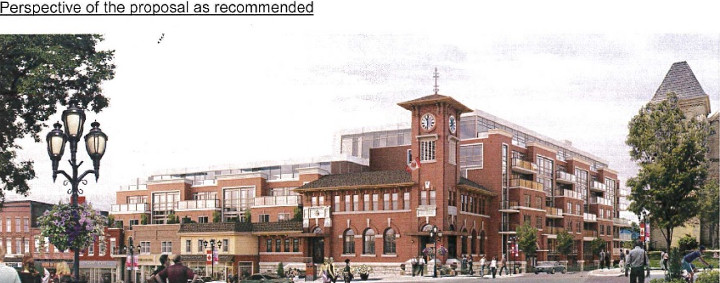
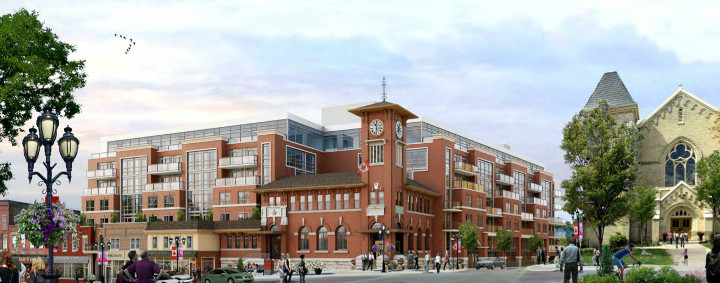
The Ward 5 by-election should be a referendum on the Clock Tower. Because a decision to redevelop will be irreversible and do huge and lasting damage to our historic downtown. 
Are the people of Ward 5 going to elect someone who believes, like the Mayor, Tony Van Bynen, that the seven storey Clock Tower development is a great example of the type of intensification the old downtown needs?
Or are we going to elect a councillor cast from a different mould, someone prepared to say no – confidently and unambiguously?
For me – and, I suspect, for many others - that is the over-riding question.
Do Signs Buy Support?
Sign wars erupt nearly every election, says York University political science professor Robert MacDermid.
It’s become part of the election fabric: first the campaign signs dotting the landscape, then the campaign-sign controversy – who placed them when and where, who stole them and why.
That’s because signs can have an influence on the outcome of a vote, MacDermid said.
“There is a weak relationship between spending more money on signs, and being more likely to win.”
Often, signs are most effective among those voters who have not followed local politics closely, he said.
Signs placed on front lawns appear to be more effective than those on public land near intersections, because lawn signs leave an impression of popular support. That’s crucial in a municipal election where no opinion polls are available to let voters know who is in the lead, he said.
It’s why money spent on signs is a key expenditure for most campaigns, he said.
“You may have a lot of money, but not a lot of support. You may have a few big developers backing you, or wealthy individuals... It allows you to manipulate that impression ... and it could mislead voters to the true level of support.”
Signs placed on private property without permission could be accidental, he said – an over-enthusiastic campaign worker, for example, or voters who inadvertently provided their contact information to a candidate’s data list.
But if it’s used as a campaign strategy, it can backfire, he said. “Any experienced campaign manager knows it’s not worth doing. It looks disorganized.”
Some residents may leave the unasked-for signs on their property, others may toss them.
“Lots of people aren’t interested in signs. It forces them to reveal a partisan belief and they don’t want to display that.
“There’s not much to gain here ... You may just annoy people who don’t want signs. It’s a gamble.
- Details
- Written by: Gordon Prentice
An email comes winging in from York Region’s Director of Corporate Communications, Patrick Casey, gently informing me that the Regional Chair only votes in the event of a tie. 
Oops!
In my earlier blog I had a glum looking Wayne Emmerson abstaining in yesterday’s vote to video stream meetings of the Council and its Committee of the Whole. We all know he did not abstain because he could not vote in the first place.
More importantly, a concerned Mr Casey noticed I was sitting below the salt at yesterday’s meeting, in the public gallery.
He has decided to promote me.
“If you wish, we have a seat at the media table that you can use when covering meetings.”
I tell him it would make me feel a bit self conscious so I have to say no.
I don’t think I’ve ever met Patrick Casey but I already know that I like him.
- Details
- Written by: Gordon Prentice
The future of a hugely popular pub on Main Street South could be imperilled if Bob Forrest gets the go-ahead for his Clock Tower redevelopment.
As we know, rumour is half way around the world before truth has got his boots on. But I hear from reliable sources that Bob believes there could be “significant structural issues” for the Olde Village Free House at 196 Main Street South if 194, which he owns, is demolished. 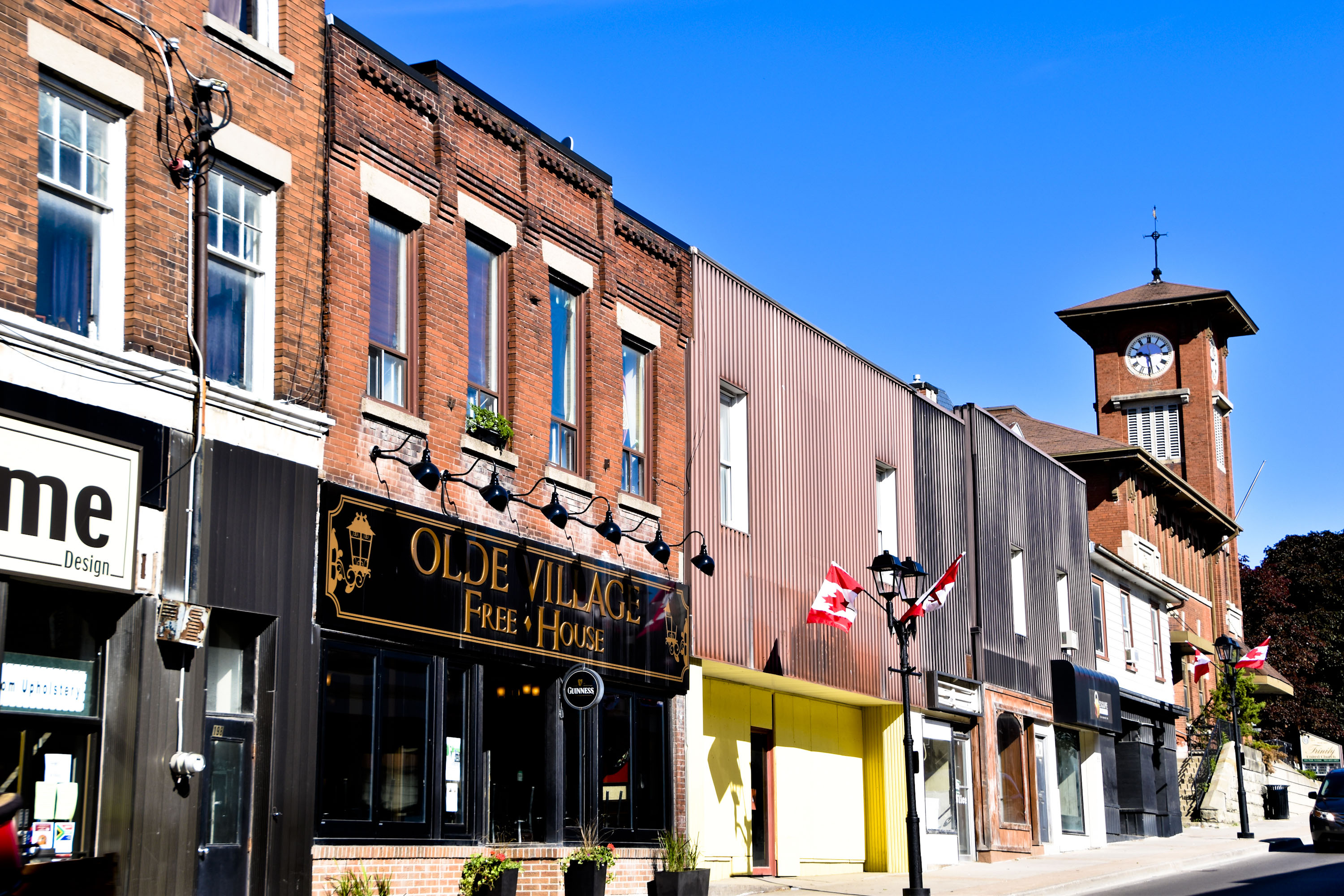
Both properties – which are designated historic commercial buildings - share an internal wall and the same roof structure. (The photo shows the building before the metal siding came down.)
The Town tells me that if Bob gets approval to redevelop the Clock Tower
“a heritage conservation plan or strategy will be required that will detail demolition techniques… it will also address adjacent structures including 196 and the portions of the Post Office that will be retained in situ.”
The Town says that if there is a common wall between the two properties (and there is)
“an engineer’s report will be required on how the structural integrity of the remaining structure will be maintained during the demolition work”.
The Town confirms there is no plan in place at the moment.
Is it even remotely possible that a wrecking ball could be smashing through 194 while, next door at 196, pub life continues as normal?
But all this is a bit premature. Bob doesn’t have permission to demolish anything yet – and in the absence of a land swap with the Town his project will never get off the ground.
One way or the other, we need a swift decision on Bob’s toxic planning application as soon as possible after the by-election on 17 October.
This has already dragged on for far too long.
Bob cannot be allowed to win a war of attrition on his terms.
The Town’s 2011 Heritage Conservation District policy, now entrenched in the 2013 Heritage by-law, says the building at 194-196 Main Street South contributes to the Town’s historic commercial character.
“It is a two storey block made of concrete block with a brick veneer façade, one half of which is covered in metal siding (in the unit where the brick veneer is exposed, upper-floor windows and parapet step upward).”
The policy document states that 194 is an identical building to 196.