Gordon Prentice at Large - Politics in Newmarket







- Details
- Written by: Gordon Prentice
The coronavirus has taken a terrible toll at one Newmarket long-term care home, Mackenzie Place, a short walk from where I live. 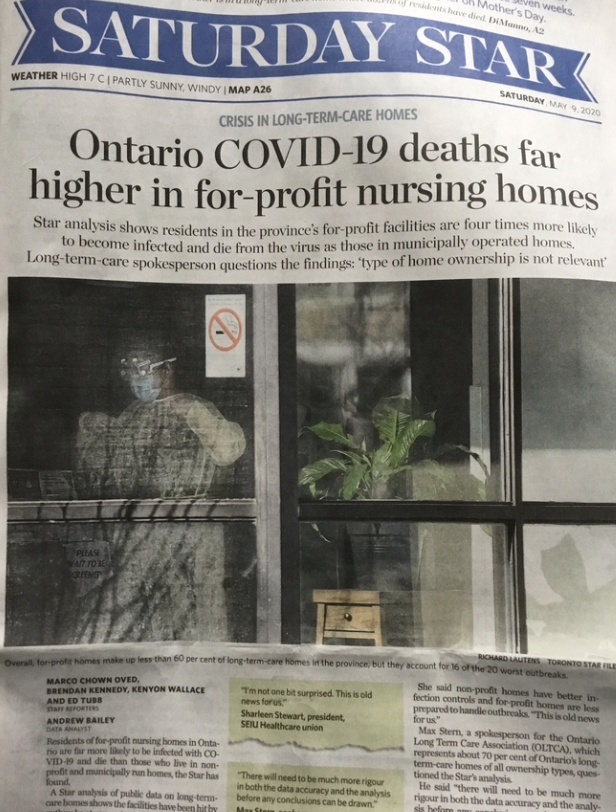
A couple of weeks ago I noticed a colourful poster on the dining room window telling passers-by:
“Heroes walk through these doors every day”.
Absolutely.
Containing the virus
The staff work valiantly to contain the virus but it spreads relentlessly. By May 8th Newmarket Today was reporting 11 deaths at the home. 78 residents and 23 staff had tested positive.
This is the biggest outbreak in York Region.
I find myself wondering why the virus cannot be contained.
The interim guidance on how to control Covid-19, published by the Public Health Agency of Canada over one month ago, on 8th April, was reassuring.
Belt and braces
To me, the guidance seemed like a real belt and braces job, spelling out the steps that should be taken to keep residents and staff safe.
However, I now learn from Jodi Hall, the Chair of the Canadian Association of Long-Term Care, that the guidance from Public Health Canada is “basically impossible” to follow in many care homes which have outdated facilities.
Many homes have “four-bed, hospital-like wards with residents separated only by a curtain”. In these circumstances, preventing cross infections is challenging.
Mackenzie Place is owned and operated by Revera, one of a number of private sector providers of long-term care.
Four times more likely
Over the weekend, the Toronto Star reported that Covid-19 deaths in Ontario are far higher in for-profit nursing homes. Its analysis
“shows residents in the province’s for-profit facilities are four times more likely to become infected and die from the virus as those in municipally operated homes.”
If this is true it is deeply worrying and begs the fundamental question of whether the private sector should be in the business of long-term care at all.
Pat Armstrong, a Distinguished Research Professor of Sociology at York University, believes long-term care should lie in the public sector. She gave her reasons to the CBC’s Michael Enright in a fascinating conversation on his Sunday Edition on 26 April. Meals and staffing are prime candidates for cost control.
Professor Armstrong paints a picture of what long-term care can be like given imagination and resources. She points to examples overseas, in Scandinavia, where long-term care offers residents a fulfilling and stimulating life.
Questions and Answers
I hope these themes can be explored by the House of Commons Health Committee when it meets on Wednesday, 13 May 2020. It will be webcast from 4pm-7pm and Pat Armstrong and Judi Hall are amongst the witnesses.
Newmarket-Aurora MP, Tony Van Bynen, is a member of the Committee and I hope he will explore the public/private issue in the time he has available.
But if this is outside the Committee's terms of reference for the current inquiry - and it may be - he may wish to focus on the guidance from Public Health Canada which is, apparently, in many settings impossible to follow.
Update on 12 May 2020: From the Toronto Star: National Standards of Care Needed says Federal Minister. And Martin Reg Cohn argues that accountablity and responsibility matter more than ownership. Cohn writes:
"The Ford government decided last year to end comprehensive annual inspections, opting instead for a complaint-based model — as if seniors suffering from dementia, or without extended families, can truly benefit from the premier’s fetish for snitch lines or online web forms. There is no excuse for not regulating and inspecting comprehensively, annually and aggressively."
Update on 13 May 2020: The Province says it is taking steps to better protect residents and staff in long-term care homes. And the Toronto Star calls for a public inquiry into the crisis in long-term care.
Update on 19 May 2020: Province announces independent inquiry into long-term care.
Update on 21 May 2020: From the Toronto Star: Long-term Care - Ontario needs the real deal.
- Details
- Written by: Gordon Prentice
During last October’s Federal Election campaign Tony Van Bynen, now MP for Newmarket-Aurora, made it explicitly clear he was in favour of a ban on handguns. 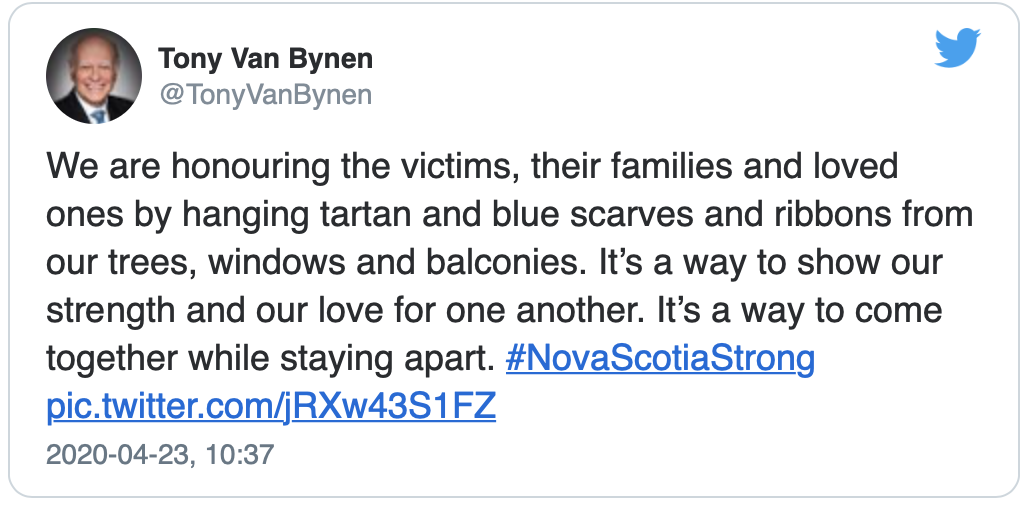
On 20 April 2020, in the wake of the mass murders in Nova Scotia, Prime Minister Justin Trudeau said the Government would strengthen gun control legislation as soon as possible.
Semi-automatic handguns
Reports in the Toronto Star this morning tell us the RCMP have confirmed that the killer was carrying several semi-automatic handguns and two semi-automatic rifles.
When the legislation comes before this minority Parliament Van Bynen’s vote will be crucially important – it carries the same weight as any other MP’s vote.
But, as a Liberal MP who believes in a nationwide ban on handguns, his voice could be particularly influential and persuasive.
He honoured the victims of the massacre in Nova Scotia on social media. A vote to ban handguns nationwide would be a lasting tribute to their memory.
My email/letter exchange with Tony Van Bynen MP and Bill Blair MP on handguns
By email and Canada Post: 29 April 2020
Good Morning Tony
Thank you for your reply of 26 April 2020 to my email of 26 January 2020. I am grateful you have taken the time to respond.
You tell me you have forwarded my 26 January email to the Minister, Bill Blair, and I have followed this up with my own email to him. It is pasted below for your information.
Mr Blair is, of course, in no position to speak for you on whether you support the Class Action against Smith and Wesson being brought by the victims of the Danforth mass shooting. Can I ask again if you support the class action?
Here is a link to the CBC’s reporting:
https://www.cbc.ca/news/canada/toronto/danforth-shooting-class-action-lawsuit-smith-wesson-1.5398684
The story in this morning’s Toronto Star confirms that the Police now know that the mass murderer in the Nova Scotia killings was carrying several semi-automatic handguns and two semi-automatic rifles. Here is the link:
https://www.thestar.com/news/canada/2020/04/28/nova-scotia-rcmp-to-provide-update-on-investigation-into-mass-killing.html
As this correspondence with you concerns matters of public policy between a constituent and an MP I am posting our exchanges on my website.
I look forward to hearing from you.
Yours sincerely
Gordon Prentice
___________________________________________________________________
By email and Canada Post: 29 April 2020
Dear Mr Blair
We are all shocked to the core by the terrible tragedy in Nova Scotia – the deadliest mass shooting in Canadian history. We hope the Government will do everything it can to minimise the possibility of such a brutal, cold-blooded slaughter ever happening again.
My MP, Tony Van Bynen, believes as I do that there should be a nationwide ban on handguns. He made his position clear during last year’s Federal Election campaign.
I wrote to Mr Van Bynen on 26 January 2020 asking for his views on a Toronto Star editorial that day which described proposals to give municipalities powers to ban handguns on their patch as an “unworkable and ineffective idea” which defied logic.
Mr Van Bynen replied to my letter on 26 April 2020 after the full horror of the massacre in Nova Scotia became known. He wrote:
Thank you for writing to me regarding banning handguns in Canada. The Prime Minister’s position with respect to gun control is clear. For ease of reference I am attaching a link to his most recent statements: https://www.thechronicleherald.ca/news/canada/trudeau-promises-swift-action-on-gun-control-in-light-of-nova-scotia-shooting-439870/
The matter is also reflected in Hon Bill Blair - Minister of Public Safety’s Mandate Letter and his approach is largely captured in the following article. https://www.theglobeandmail.com/politics/article-ottawa-to-implement-gun-control-strategy-in-multistep-process-bill/ I will submit your email correspondence to Minister Blair.
Tony Van Bynen MP
Newmarket-Aurora
Although Mr Van Bynen did not make it explicitly clear, I am bound to assume that in forwarding my correspondence to you he is inviting you to address the points I raised with him concerning (a) the feasibility and workability of a partial handgun ban and (b) the questions I had asked him to table.
Are you in a position to comment on the point made in the Toronto Star editorial about the impracticability of a partial handgun ban? And would it be possible for you to answer the questions I asked Mr Van Bynen to table?
Can I ask you to acknowledge receipt of this email and indicate if I can expect a substantive reply to the points I raise?
I am very grateful.
Yours sincerely
Gordon Prentice
__________________________________________________________________
From: Gordon Prentice <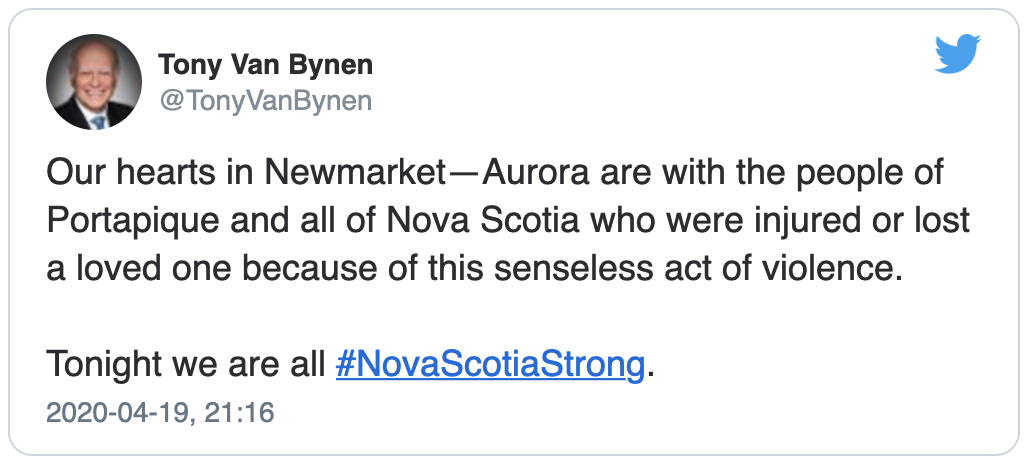
Sent: Monday, April 20, 2020 5:32:45 PM
To: Van Bynen, Tony - M.P. <
Subject: The Massacre in Nova Scotia
By email and by Canada Post
Good afternoon Tony
In the light of the terrible massacre in Nova Scotia and your Tweet #NovaScotiaStrong I am writing to ask you again what steps you are taking to advance a ban on handguns, a policy you favour.
I should also be grateful if you would address the points made in my letter of 26 January 2020.
Gordon Prentice
__________________________________________________________________
By email and by Canada Post
Tony Van Bynen MP
House of Commons
Ottawa K1A 0A6
26 January 2020
Good afternoon Tony
Banning handguns
I am writing to you again because we share a common objective to see handguns banned in Canada.
This morning’s Toronto Star editorial calls for a ban on handguns and says the Prime Minister’s mandate letter to Bill Blair in December only mentions assault rifles.
“On handguns, it speaks only of working with provinces and territories “to give municipalities the ability to further restrict or ban handguns” — the position the Liberals campaigned on last year.
This is an unworkable and ineffective idea. The idea that individual cities can usefully impose bans on handguns defies logic…”
https://www.thestar.com/opinion/editorials/2020/01/26/banning-assault-rifles-is-fine-but-handguns-are-the-problem.html
What are your thoughts on this?
At the bottom of page 4 of this morning’s Star there is a short piece about a fatal shooting last night in Scarborough – Bill Blair’s own patch. One man was shot in the chest and died and another was shot in the head and is in hospital with life threatening injuries. A woman was shot in the hand.
This kind of gun violence is becoming normalised with stories which would once have appeared on the front page being found deep inside the paper.
As Parliament returns this coming week after the Christmas break, would you (a) raise this issue of gun violence at the next Liberal caucus and (b) seek a meeting with Bill Blair to ask how he intends to respond to the plague of handgun violence. How will the plan to give individual cities the right to impose bans on handguns work in practice?
I wrote to Bill Blair twice during the Government’s consultation on firearms.
I should also be grateful if you would table these written questions:
(1) What estimate the Minister has made of the cost to Municipalities of (a) implementing and maintaining a local ban on handguns or (b) restricting access to handguns?
(2) If the Minister will make it his policy to collect statistics on the number of people who have been left permanently disabled as a result of a handgun assault, specifying in each case the nature of the injury?
(3) How many persons under the age of 18 have been (a) fatally shot and (b) wounded in each of the last 10 years by someone using a handgun?
On 16 December 2019 I wrote asking if you would support the class action lawsuit brought by victims of the Danforth shooting against gun maker Smith and Wesson. The story is set out here in the Globe and Mail:
https://www.theglobeandmail.com/canada/article-toronto-danforth-shooting-victims-lawsuit-gun-maker-smith-wesson/
Can I ask when you are likely to be in a position to respond?
I look forward to hearing from you.
Your sincerely
Gordon Prentice

Danielle Kane, shot in the Danforth, left paralysed from the waist down.
Update 29 April 2020: From the Globe and Mail: Canada set to ban assault-style weapons.
Update 1 May 2020: From the Globe and Mail: Trudeau announces ban on assault style guns. And will the rampage in Nova Scotia prove to be a pivotal moment? And from the Toronto Star: Much more must be done.
Update on 3 May 2020: From the Globe and mail: Trudeau's hurried assault weapon ban is a weak half measure.
"Most puzzling of all is the government’s stance on handguns. It has no intention of banning them in Canada; at best, as Mr. Trudeau repeated on Friday, Ottawa will give municipalities the power to restrict or ban handguns within their own jurisdictions.
That is an odd choice, and an empty gesture. If a ban on military-style semi-automatics is an effective way to reduce the number of weapons in circulation and available for mass shootings, then surely a similar ban on handguns – which also have no legitimate civilian purpose, and which kill and wound more Canadians every year than any other firearm – would have a similar effect. Friday’s announcement accomplished two things. It banned a style of weapon that has no place outside of the military, but it also reminded people who care about gun control that the Liberals have been inconsistent and at times illogical in their approach to the issue."
- Details
- Written by: Gordon Prentice
Yesterday Doug Ford announced that 350,000 front-line workers battling against Covid-19 will be getting a $4 per hour increase in their wages for four months. The Premier described this as “pandemic pay” for “pandemic heroes”. 
“This increase will provide four dollars per hour worked on top of existing hourly wages, regardless of the qualified employee's hourly wage. In addition, employees working over 100 hours per month would receive lump sum payments of $250 per month for each of the next four months. This means that eligible employees working an average of 40 hours per week would receive $3,560 in additional compensation.
Those eligible to receive the payment will be staff working in long-term care homes, retirement homes, emergency shelters, supportive housing, social services congregate care settings, corrections institutions and youth justice facilities, as well as those providing home and community care and some staff in hospitals.”
Those entitled to the wage boost include Personal Care Workers, nurses and care assistants.
Good News
This is good news – especially for those who earn the minimum wage. Last year’s budget kept the minimum wage at $14 an hour with Ford claiming a tax break would give low paid workers a better deal.
Ford’s Deputy, Christine Elliott, has never been in favour of the minimum wage.
She says there has to be a balance between the minimum wage and businesses being able to absorb the cost.
Wage Restraint for the low paid
There always seems to be a good reason why low wages can’t be raised. But the coronavirus has changed all that – at least for the next four months.
It was all very different in November 2010, ten years ago, when the then Opposition Health and Long-Term Care Critic, Christine Elliott, excoriated the “McGuinty Liberals” for not freezing wages in long-term care homes. Then, as now, the Provincial Government was trying to rein in wage increases in the public sector. 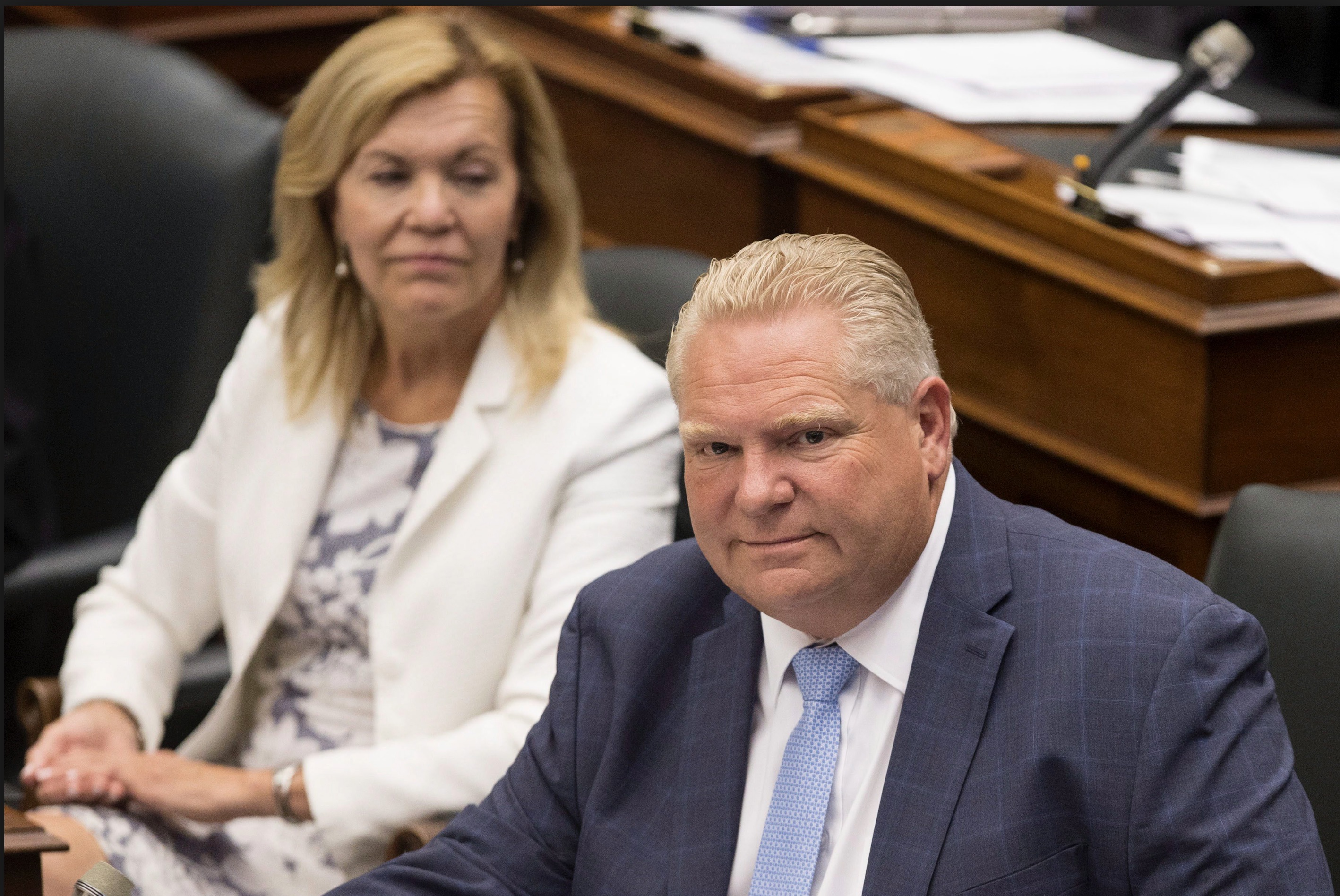
In September 2010, an arbitrator had awarded a one year, 2 per cent increase to most workers in Extendicare, Chartwell and other private for-profit care homes.
The care homes had “demanded” that a wage freeze apply to 17,000 nurses and other employees and Elliott took up the cudgel on their behalf. (Click "Read More" below.)
She warned MPPs:
“Homes will have no choice but to lay off 1,300 nurses and seniors’ care providers if the Premier continues backtracking from his wage restraint plan.”
Groundhog Day
In April 2019, not long after its election, the Ford Government was calling for a
“voluntary agreement to wage outcomes lower than the current trend.”
By November 2019, the Government had legislated
“to cap public sector wage increases at an average of one per cent annually for the next three years.”
Where does this leave front-line workers after the pandemic subsides?
Are Ford’s “pandemic heroes” going to fall back to the end of the line again?
From hero to zero in four months.
Or will we see a new settlement with terms and conditions that reflect their status as key workers on whom our most vulnerable depend?