Gordon Prentice at Large - Politics in Newmarket




- Details
- Written by: Gordon Prentice
This is a postscript to my last blog in which I expressed scepticism that the land donated by the developer, Marianneville, to the Town could be valued at over $14M. This is not funny money. It is bankable. The Tax Receipt issued by the Town will be used by the developer to offset tax otherwise owing to the Canada Revenue Agency. 
The Valuation Report jointly commissioned by the developer and the Town makes several “extraordinary assumptions”.
The valuer reserves the right to
“amend, alter, or otherwise change the final estimate of Market Value should any Extraordinary Assumption contained or identified herein prove to be invalid.”
Extraordinary Assumption
One very significant “extraordinary assumption” concerns the two stormwater ponds which lie in the donated lands. The valuer says:
“These are being considered, consistent with the industry norm, on the basis of being otherwise developable.”
Here comes the health warning – I am not a valuer or a pretend valuer but common-sense tells me it is a step too far to consider the stormwater ponds developable. Against this, we are told this is the way valuers do things and it is the industry norm.
Of course, stormwater ponds are not there in perpetuity. No doubt, advances in technology make a difference. But the two stormwater ponds on the donated land (ponds 12 and 13) continue to serve a purpose. (see note 1 below)
Stormwater ponds retained elswhere
In the rest of Glenway West the two existing stormwater ponds (10 and 11) have been retained and are being incorporated into the new development. No doubt because they fulfill a function.
The Town’s Comprehensive Stormwater Management Master Plan (June 2017) goes into huge detail about how and why these stormwater ponds are needed. I learn there are approximately 100 SWM ponds in Newmarket, 58 of which are owned and operated by the Town.
Ponds 12 and 13 on the donated land are permanent “wet ponds” and provide water quantity and quality control. There is nothing in the Master Plan that suggests they are no longer needed.
The table on the right (Table 3-7) tells us more about all the ponds in Newmarket. (The graphic shows an extract with statistics on ponds 10 to 13 at the bottom.)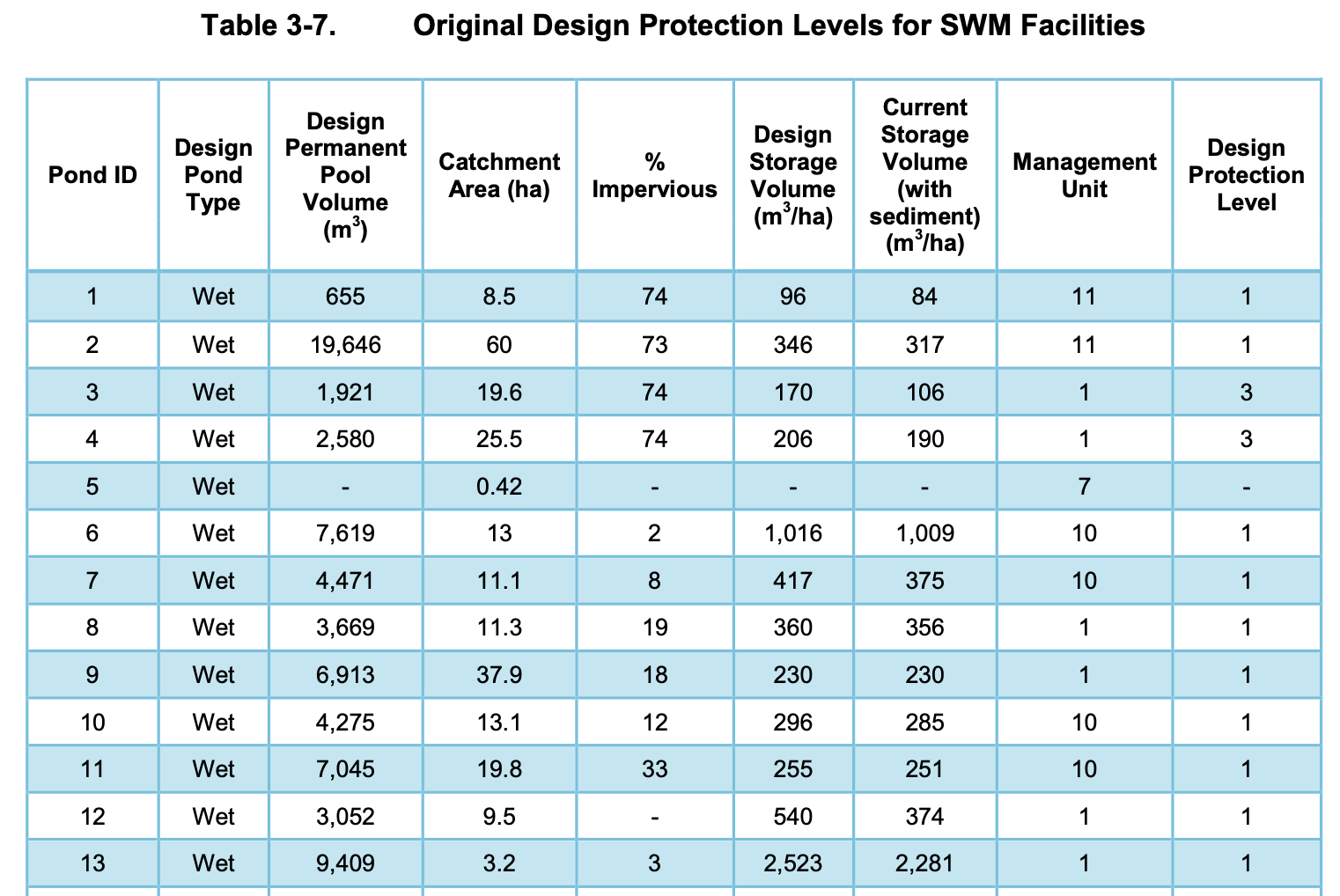
Ponds hold a lot of water
Pond 12 lies to the west of pond 13 and is the smaller of the two. Pond 12 has a design pool volume of 3,052 cubic metres and its sister to the east, pond 13, has a design volume of 9,409 cubic metres. An Olympic size swimming pool holds about 2,500 cubic metres of water.
The catchment area of pond 12 is over 23 acres and pond 13, almost 8 acres.
The valuer makes the extraordinary assumption that the two stormwater ponds are part of the 10.21 acres which are allegedly developable. If so, what happens to the water that they are designed to catch, hold and allow slowly to drain away through the soil?
Two ponds = 2.19 acres
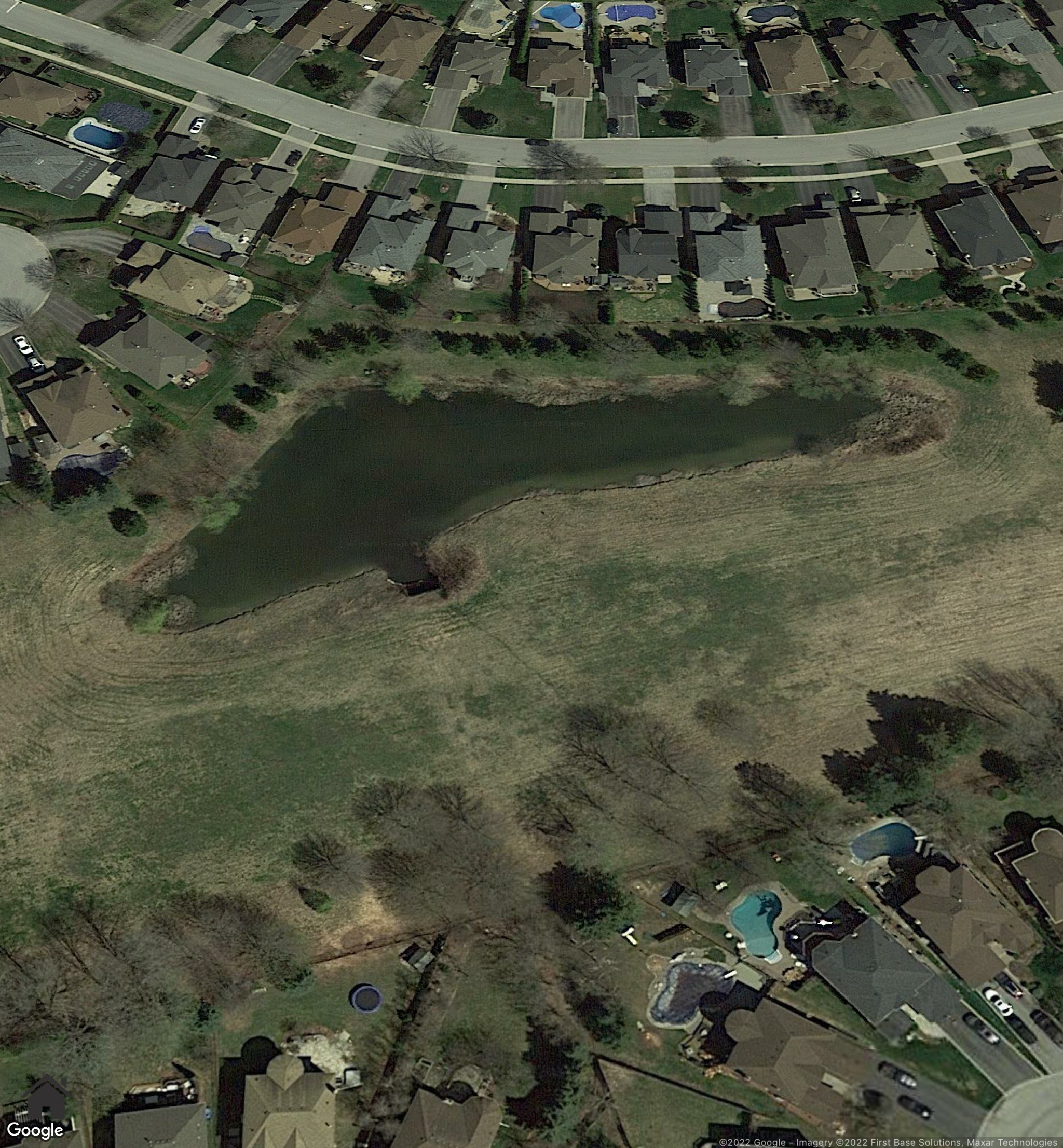
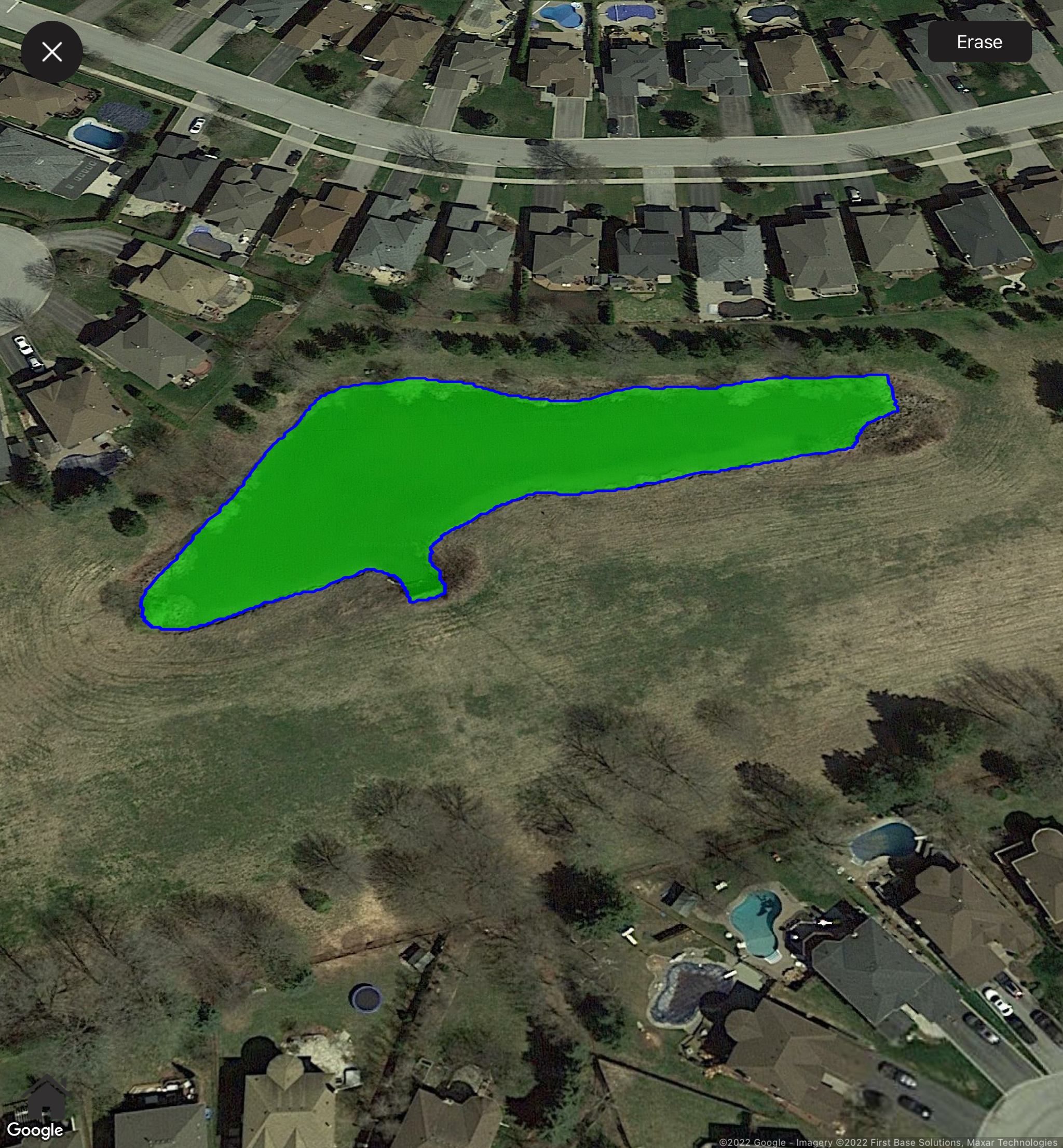
The view of pond 12 shown below in my solid green is 0.82 acres.
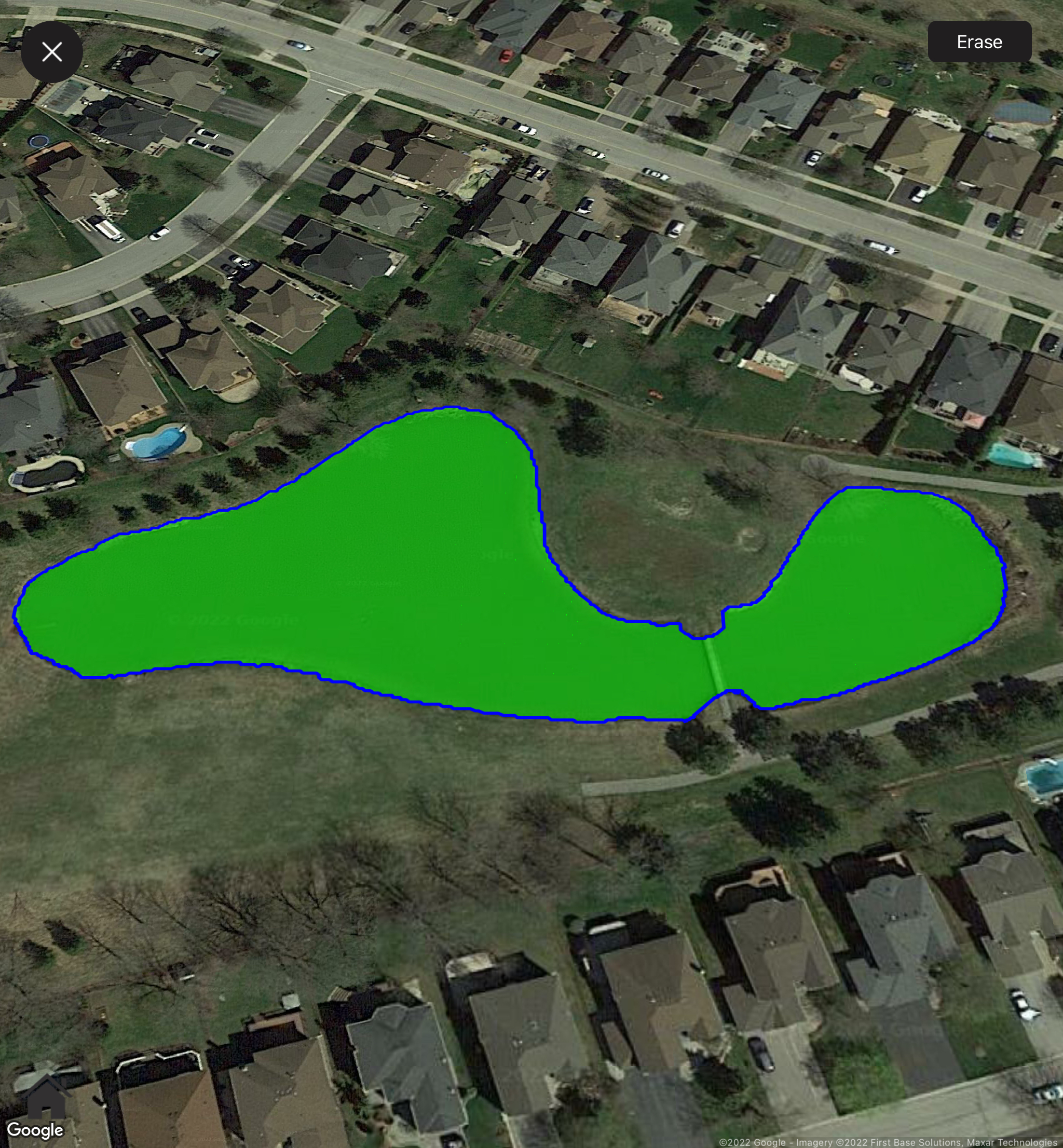
Pond 13 is 1.37 acres.
If the ponds were to remain, plainly the amount of land available for development would be reduced - along with its estimated market value.
What would the Stormwater Master Plan say?
I find it difficult to believe the stormwater ponds are developable. But if they are, how would their removal be addressed in the Town’s Comprehensive Stormwater Management Master Plan?
Seems to me the valuer's "extraordinary assumption" is invalid.
And if so, the market value of the donated land needs revision.
Update on 23 March 2022: From the Canada Revenue Agency:
The onus is on charities to ensure that the fair market value reflected on official donation receipts is accurate.
Municipalities are charities.
Note 1: update on 27 March 2022: From page 30 of the Valuation Report: SITE SERVICES AND UTILITIES: The Parent Property site is serviced with a complement of facilities including asphalt paved and curbed roadways, municipal water supply, sanitary and sewers, hydro and natural gas. Drainage is currently largely directed in a southern direction towards two ponds in its southwestern area.
Stormwater Pond 12 with the pond area calculated as 0.82 acres below:
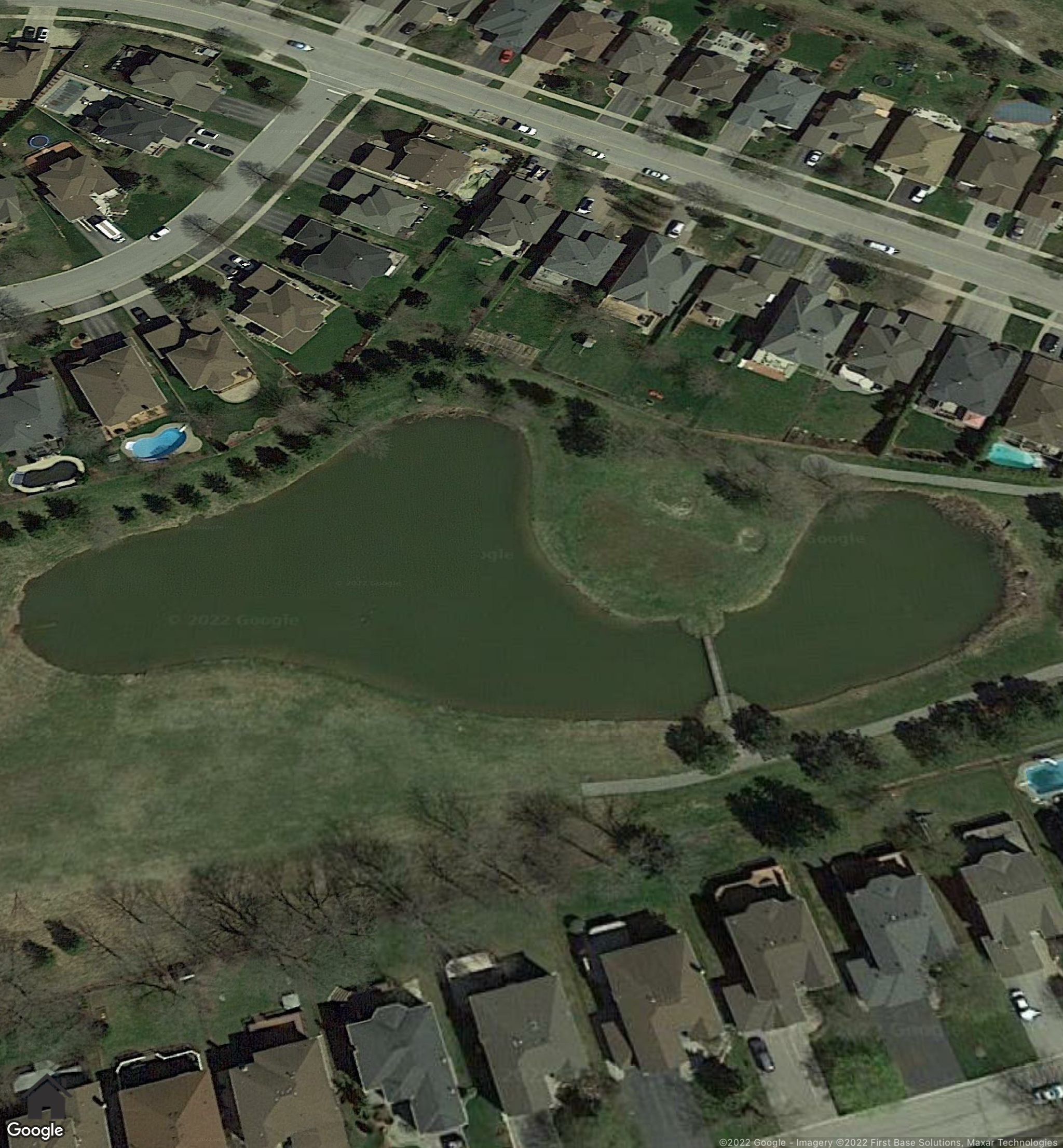
Stormwater Pond 13 and the pond area calculated as 1.37 acres below:
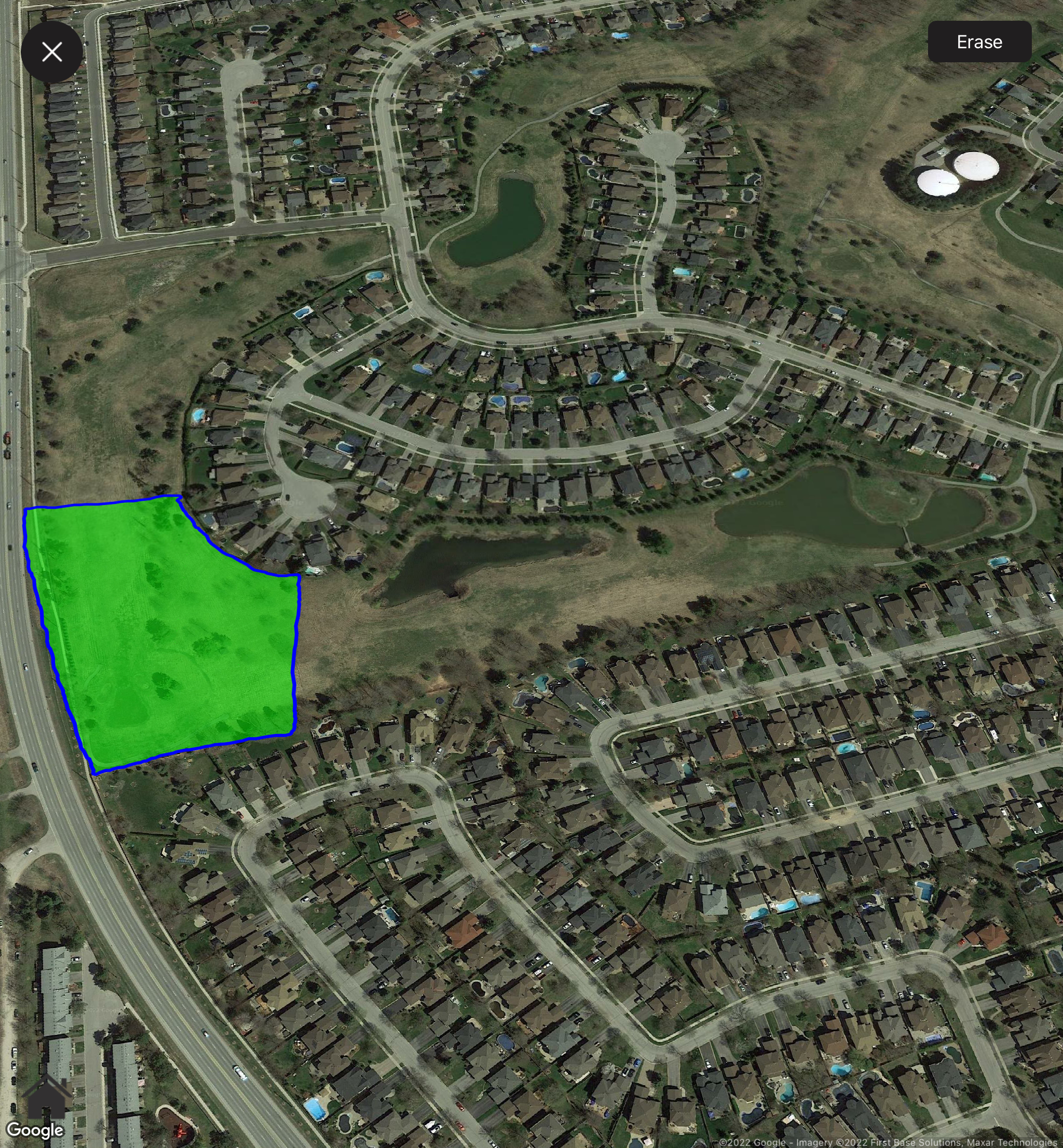
The Valuation Report says the land in green below is municipal open space and is undevelopable. So the development that is theoretically envisaged by the Valuation Report would be pushed to the East towards the stormwater ponds.
- Details
- Written by: Gordon Prentice
On 14 December 2021 the Town gave a Donation (or Tax) Receipt for $14,290,000 in exchange for a 15.92 acre parcel of land at Glenway West which was gifted to the Town by Marianneville who didn't want it. The donation was agreed and publicized with great fanfare in June 2017. The title would transfer at a time of the Town’s choosing. 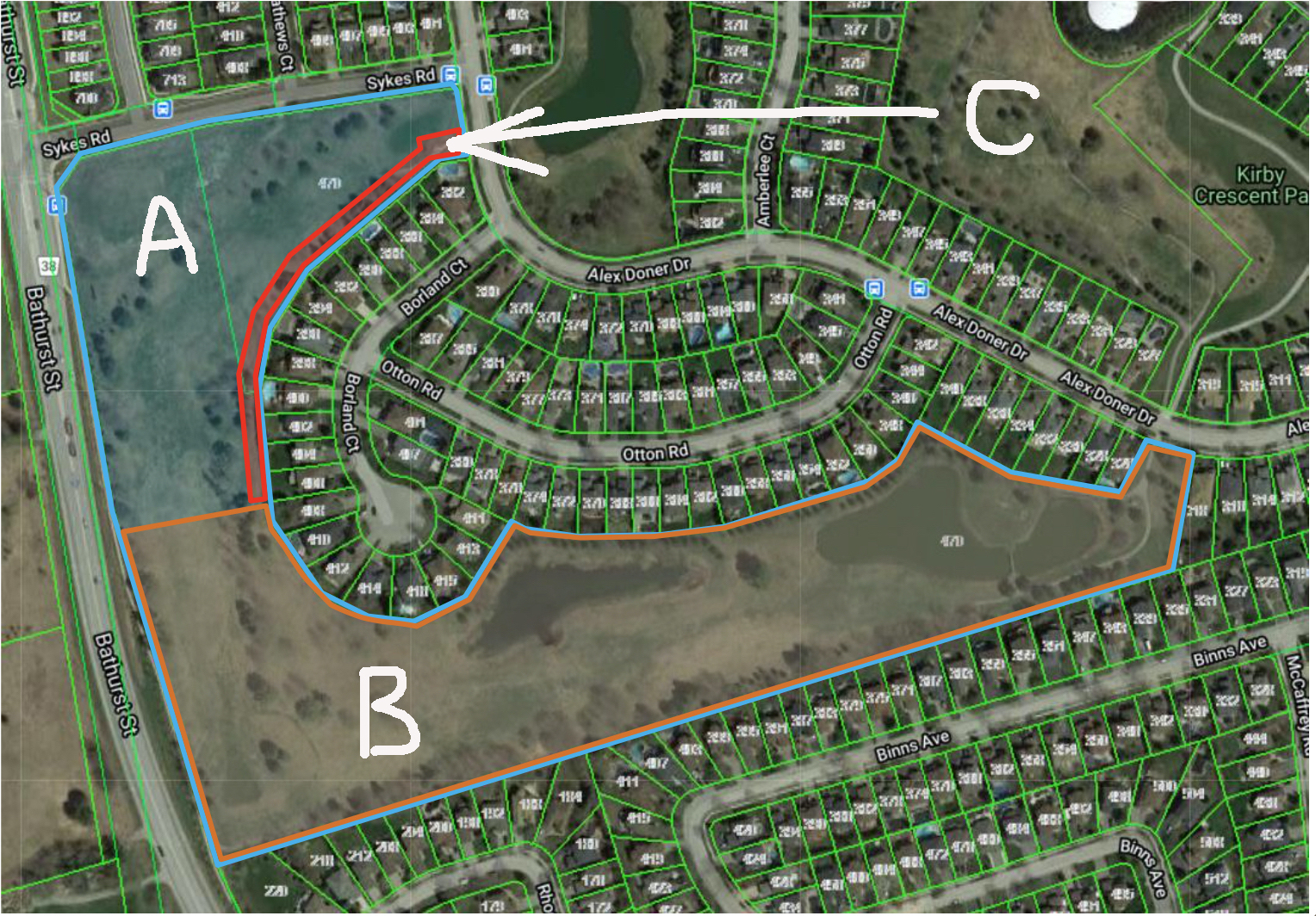
A tax receipt issued in exchange for a charitable donation can be used to offset taxes owing to the Canada Revenue Agency. It is as good as real money.
Background: The 140-acre golf course at Glenway was bought by the developer Marianneville on 21 January 2010 for $9,900,000 – around $71,000 per acre. The then owner - Glenway Country Club (1994) Limited - had offered it to the Town in 2008 but the Town wasn’t interested. Marianneville then went to the OMB in 2014 to get the golf course zoning changed from private open space to allow residential development. They succeeded.
The Mayor at the time, now Newmarket-Aurora’s Liberal MP, Tony Van Bynen, said the Town had stood shoulder to shoulder with local residents, valiantly fighting at the OMB to defend the Town’s Official Plan which showed Glenway as open space. This version of events is a complete fiction. The then Director of Planning, Rick Nethery, said the Town did not defend the Official Plan at the OMB. In fact, the Town’s planners boycotted the hearings and the Town’s case was put by an outside planner with limited knowledge of the Town’s planning policies and history.
Two Issues
Fast forward to December 2021… How did the land donation translate into a tax receipt for $14,290,000? There are two issues here (a) the rules which apply for offsetting tax otherwise owed to the Canada Revenue Agency and (b) whether the donated land could realistically be developed for medium density housing as suggested by the valuers, giving it a market value of over $14M.
The CRA rules on charitable donations of real property (ie land)
The CRA has strict rules which govern donations to charities (whose definition includes municipalities). The gift must be irrevocable and come with no strings attached. Crucially, the CRA needs to know the fair market value of the property at the time the gift was made.
The valuers estimated the fair market value of the donated lands on 26 February 2021:
“Any estimate of Market Value concluded in this Appraisal Report is based upon market conditions as (sic) the Effective Date of Valuation (ie 26 February 2021). This Appraisal Report does not provide a prediction of future or prospective Market Value.”
The donation receipt (and, presumably, the transfer of title) was made nine months later, on 14 December 2021.
The Valuers say their estimate of $14,290,000 is the most probable price the property could achieve “after reasonable exposure in a competitive market…” The Appraisal Institute of Canada says the concept of “reasonable exposure time” includes adequate, sufficient and reasonable marketing effort. It begs the question – how would the donated land, open space with two storm water ponds, be described and marketed? They would be marketed as land theoretically ripe for development. But they are not.
Donation Policy 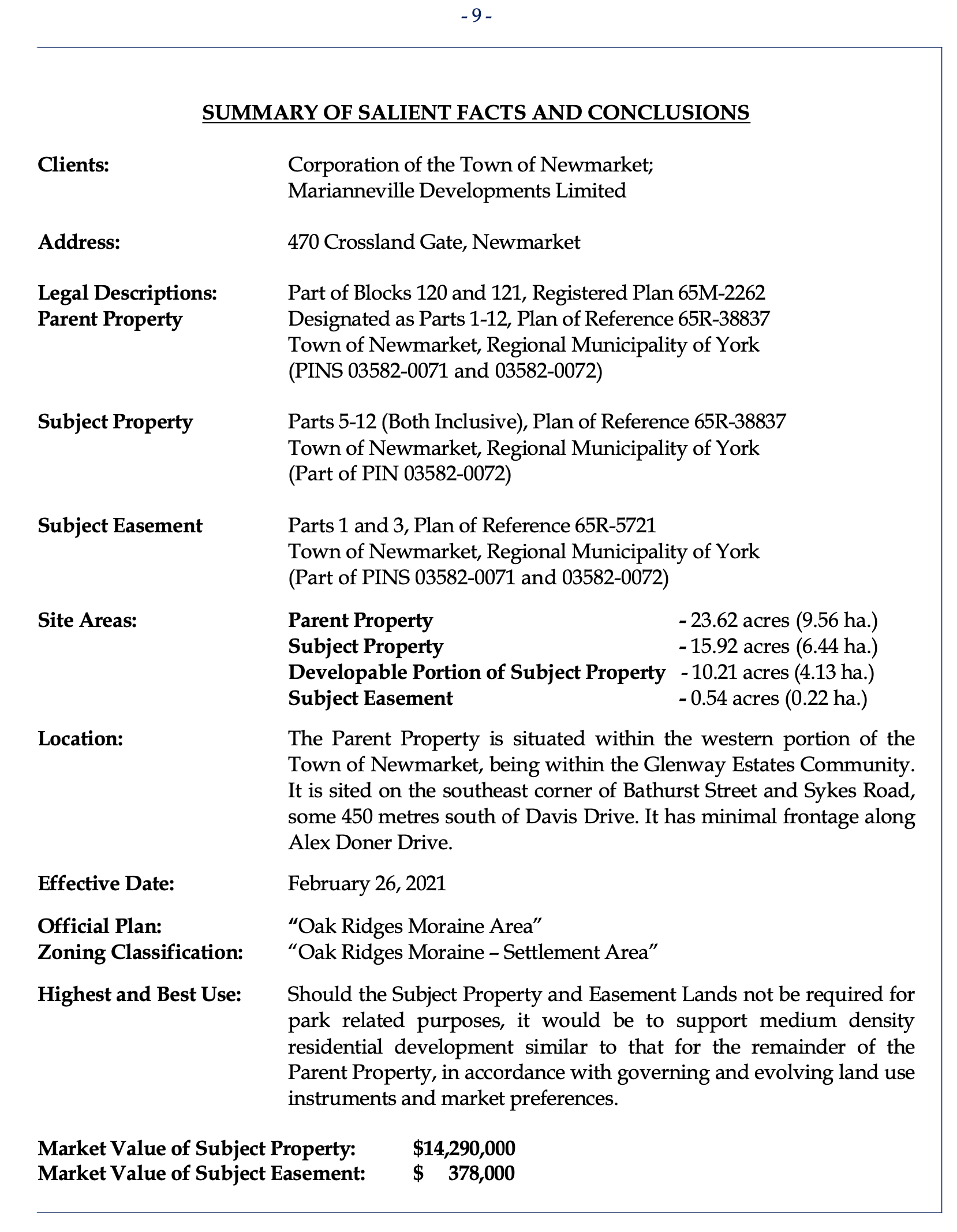
The Town accepts gifts in line with its donation policy. It says:
“Donations will not be accepted from persons who have a concurrent application of a permit or license from the Town or an application for planning approval from the Town, or from persons who are bidding for a contract from the Town through a procurement process.”
After the OMB’s decision in 2014, the Town and Marianneville were locked in an embrace, whether they liked it or not. Development was going to happen but the terms still had to be negotiated.
On 7 June 2017 the Town announced that an agreement had been reached with Marianneville who had decided to donate 16 acres of land around the former golf course’s 16th hole for public open space.
Gift of land separate from planning approvals
The Town emphasised that the donated land and any planning applications to develop the Glenway lands were to be regarded as completely separate. In their agreement on 9 May 2017 Marianneville acknowledged
“…that the terms of this agreement do not constitute in any way an approval of any future development proposal for any part of the lands known as the former “Glenway” lands, and that the owner shall still be required to proceed with the normal approval process for any future development of these lands.”
However, there was one thing that Marianneville wanted from the Town – a Tax Receipt.
“In consideration of the conveyance of the Lands and Stormwater Management Lands to the Town, (ie the donated lands) The Town agrees to provide a tax receipt to the Owner, as permitted under guidelines by the Canada Revenue Agency, reflecting the fair market value (FMV) of the (donated lands) and to place a recognition plaque within the (donated lands) acknowledging the donation of these lands to the Town.”
“The FMV will be determined by an appraisal of the Lands jointly commissioned by the Town and the Owner…”
The Valuers say their Report was commissioned:
“to assist in asset valuation related matters.”
Plainly, its primary purpose was to facilitate a Tax Receipt for the developer.
But is the land worth $14,290,000?
This is the second issue.
The donated land is in the Oak Ridges Moraine and is zoned as Open Space. It is marked “B” on the plan above and is referred to as the “subject property” by the valuers.
It lies directly to the south of a block earmarked for Townhouse development (marked as “A” on plan). Together “A” + “B” + “C” (an easement "C" allows for a proposed trail to loop through the new development) constitute the so-called “parent property”.
Marianneville’s Joanne Barnett told Newmarket Today on 30 December 2021 that the donated lands around the former 16th hole of the golf course worked for a trail system but were less suitable for housing:
“They supported two stormwater ponds and segued nicely into the woodlot there. It was a nice fit.”
But the valuers, commissioned jointly by the developer and the Town - with a brief to estimate the fair market value of the donated land should it “not be required for park related purposes” - say the land is suitable for medium density residential development.
Market Value for the Highest and Best Use of the land
To get the estimated market value, the valuers chose to compare the townhouse block “A” with its planned 96 townhouses to the donated block “B”. They say their appraisal report has been:
“completed in accordance with the Canadian Uniform Standards of Professional Appraisal Practice as adopted by the Appraisal Institute of Canada.”
The Institute says that when giving an opinion on the “Highest and Best Use” of a property the appraiser should give an opinion
"on the land, as if vacant, and the property, as improved"
Here, the valuers only give an estimate of the donated land as developed – not as undeveloped open space.
The Institute says that providing an estimate of market value for the land alone depends on the "scope of the assignment".
Stormwater Ponds
The donated land sits, in part, on a Significant Water Recharge Area and contains two large Storm Water Ponds. It is surrounded on three sides by a long-established residential neighbourhood characterised by single detached houses. The valuers say that of the 15.92 acres 10.21 are developable.
“Part 5, Plan of Reference 65R-38837 has an area of 5.71 acres and represents lands intended for green space or other municipal purpose. For the purposes of this Report, these lands are assumed to be non-developable.”
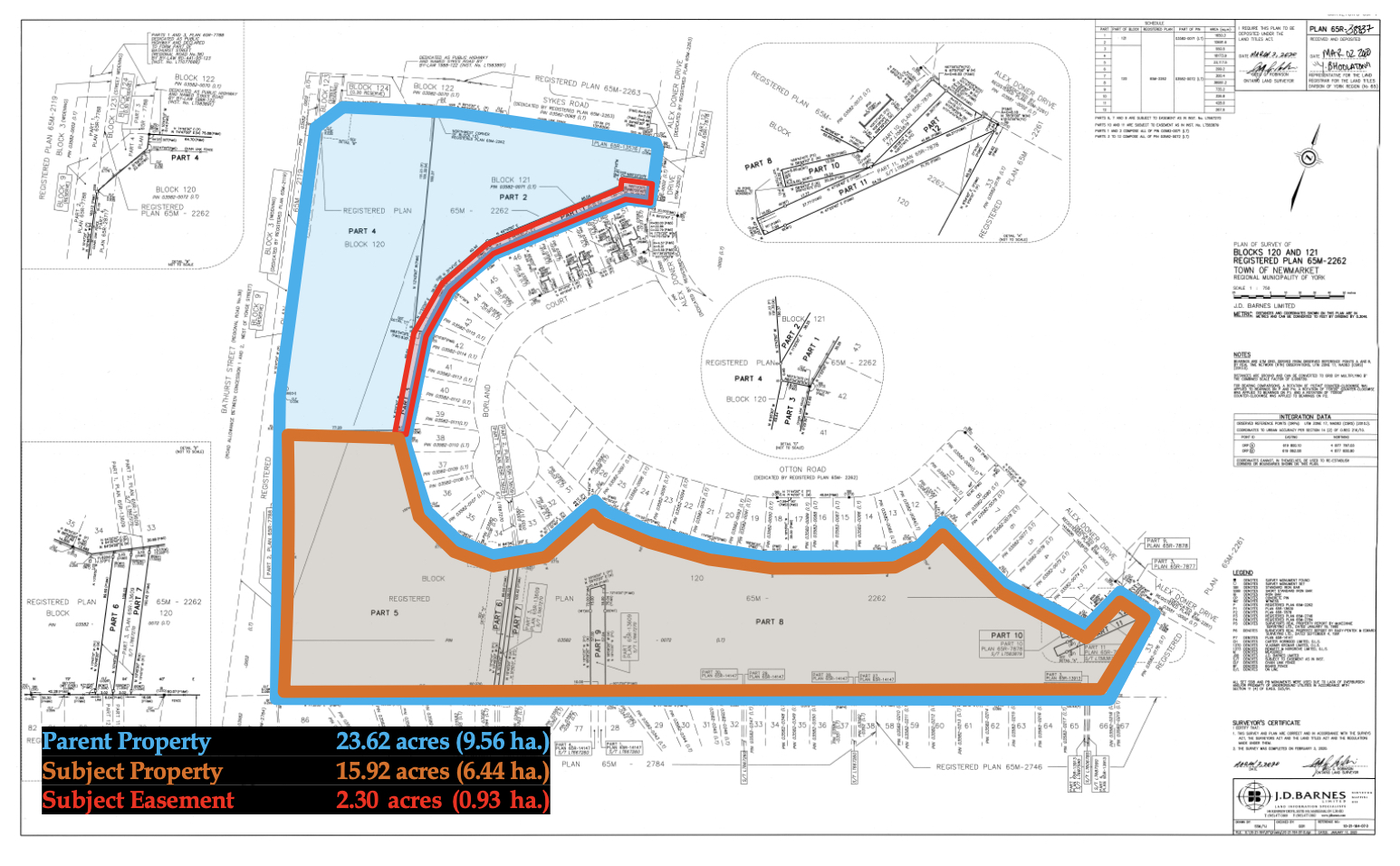
The undevelopable portion of the donated lands lies in the western third, alongside Bathurst Street. (See plan below)
The argument for a townhouse development on Block “A” turned, in large measure, on its adjacency to Bathurst.
Extraordinary Assumptions
The valuers make several “extraordinary assumptions” in arriving at the fair market value of the donated land. The two stormwater ponds
“are being considered, consistent with the industry norm, on the basis of being otherwise developable.”
But this is absurd. Other plans submitted by the developer show drainage patterns on adjacent lands, feeding water into the two ponds which are now deemed by the valuers to be developable.
The valuers say they reserve the right to amend their final estimate of market value should any of their extraordinary assumptions “prove to be invalid”.
Developing stormwater ponds is one assumption that is certainly invalid.
Flawed
The Valuation Report is flawed in other respects. Plans are incorrectly labelled. For example, in the graphic on page 29 they confuse the Parent Property with the so-called Subject Property. The key agreement between the Town and Marianneville dated 9 May 2017 is mistakenly dated 18 January 2017 – the date of the earlier agreement.
The valuers did not formally search the Title on the Land Registry. Instead, they relied on secondary sources. They say:
“A review of these sources has indicated that the Parent Property was purchased by Marianneville Developments Limited from Glenway Country Club (1994) Limited on January 21, 2010 for a total consideration of $9,900,000”
This is incorrect.
The Parent Property (“A” + “B” + “C”) totals 23.62 acres or about one sixth of the 140-acre Glenway Golf Club purchased by Marianneville in 2010.
Significant Water Recharge Area
The donated land and the block to the north proposed for townhouse development both straddle a Significant Water Recharge Area where rain and melting snow can easily penetrate the soil and replenish the aquifer which lies under the Town. (Shown in solid striped pink)
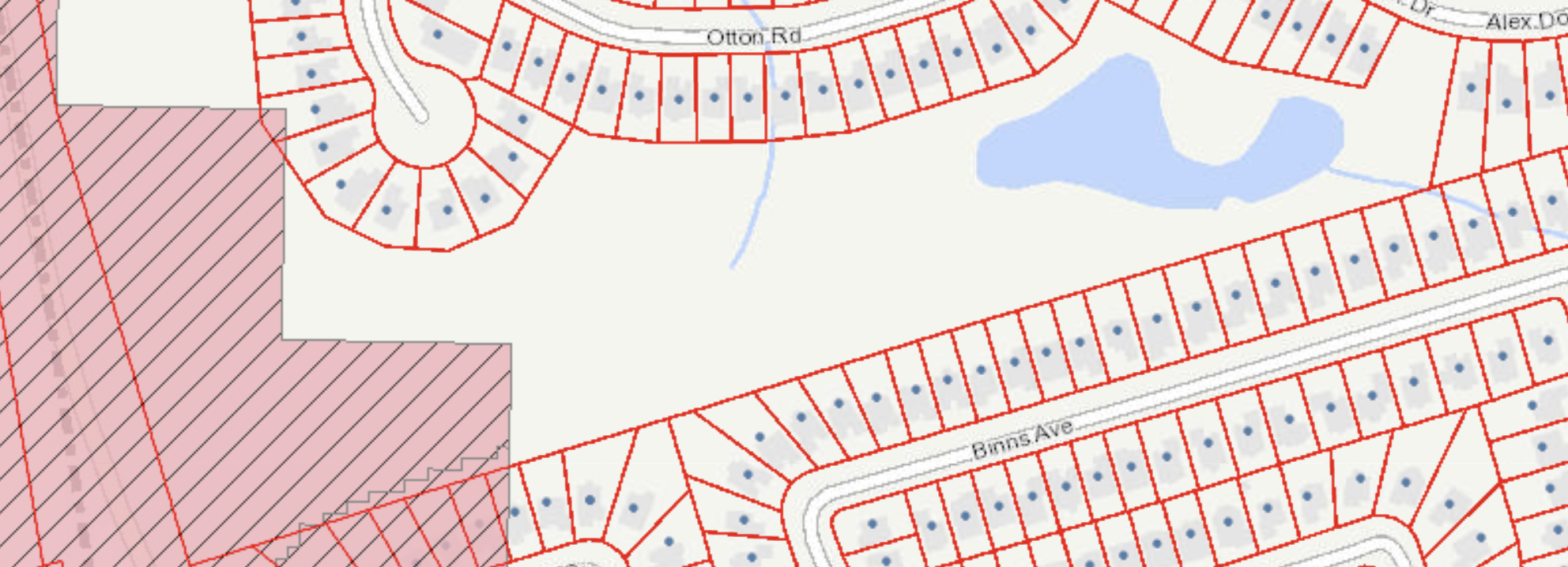
The valuers say they have no knowledge of soil conditions but they are “assumed to be adequate for intended uses”.
The Lake Simcoe Region Conservation Authority confirms it is possible to build on a Significant Water Recharge Area but it must be a “low impact development” where the amount of water penetrating the soil must be the same pre and post development – the so-called water balance. This is not a straightforward matter. Across the proposed development the amount of water seeping into the soil post-development compared with pre-development is estimated to decrease by the annual equivalent of two Olympic sized swimming pools. That is an issue that has to be - and will be - addressed. It was flagged up as an issue early on by Cole Engineering who warned of the:
"potential long-term impacts to the groundwater system associated with the development include: reduction in infiltration, introduction of preferential pathways for contaminants such as road salt, and reduction of quantity of groundwater available to nearby shallow well systems. Existing shallow water table and proposed site grading could also influence groundwater seepage into the basements in the proposed development." (Click "Read More" below)
These ‘low impact developments” are still innovative. The Director of Planning, Jason Unger, told a Council workshop on “development and the environment” on 21 March 2021 that:
“It wasn’t all that long ago that they (low impact developments) were kinda rare… but now we are looking to see (LID) right up front. So (we ask developers) what are you doing from an LID perspective and Stormwater Management perspective?”
Would townhouses fit in if the donated land were developed?
Any new development would have to be compatible with the surrounding established neighbourhood. The issue of compatibility has always been key to the development of the former golf course.
At the Statutory Public meeting on 3 February 2020 many residents – including the Ward Councillor, Christina Bisanz, expressed concerns about the density of the Townhouse block (Block A). The developer has since proposed some design changes to the Townhouses and points to the separation between the Townhouses and Borland Crescent (where the trail is planned to run) but has said nothing about the overall density. The developer's presentation slides are here. And the video of the meeting at 7pm is here.
The Compatibility Interface Plan, drawn up by the developer’s planning consultants, Zelinka, says:
“The new 3-storey townhouse dwellings will not abut any existing single detached dwelling lots.”
But a development on the donated Block "B" cannot avoid abutting the existing single detached houses – especially since the development would have to be pushed away from the Bathurst Street frontage. This would inevitably bring compatibility issues with it. This is not addressed in the Valuation Report but is central to any assessment of what could likely be built on the donated land.
For all these reasons I believe the valuation is unsafe.
The Canada Revenue Agency should ask for a new valuation of the donated land before the tax receipt for $14,290,000 can be used by Marianneville to offset tax otherwise owing.
Note: The two agreements between the Town and Marianneville dated 18 January 2017 and 9 May 2017 and the Valuation Report were made available to me following Freedom of Information requests.
See also my earlier blog from 25 January 2022. Is the land worth $14M?
Update on 20 March 2022: Text corrected to show estimated water infiltration is calculated across the development and not just from the Townhouse Block. The Beacon Environmental Impact Study (June 2021) (For details: Click "Read More")
- Details
- Written by: Gordon Prentice
The anchor of the TVO’s Agenda program, Steve Paikin, said on Monday that a serious journalistic mistake about allegations of sexual misconduct by Patrick Brown likely cost him the premiership of Ontario in 2018. 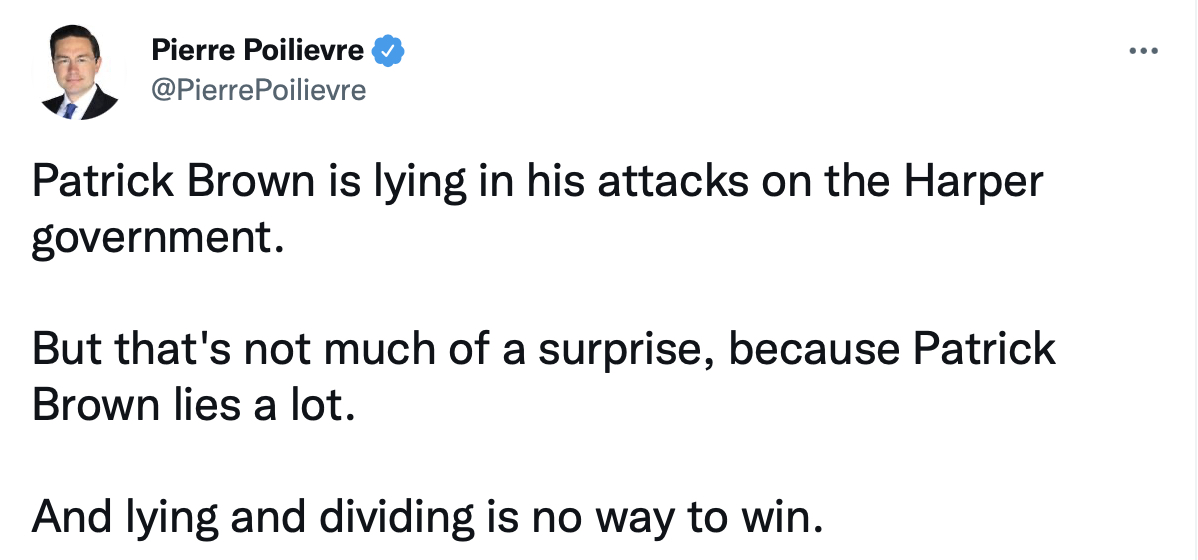
That’s fanciful and I told Paikin so.
In his column Paikin failed to mention a damning report from the Province’s Integrity Commissioner which would have been considered by the Ontario Legislature had Brown not resigned first. The Commissioner, David Wake, said Brown’s failure to disclose relevant facts about his finances was, on the evidence,
“deliberate and not through inadvertence”.
I don’t believe something like that – deliberately lying to the Integrity Commissioner (who is an officer of the Provincial Parliament) - should be swept under the carpet or be regarded as something of little or no importance.
Public expect politicians to behave badly
Paikin says he totally disagrees with me:
"The public tends not to take notice of things like reports from the integrity commissioner of Ontario"
and that
“polls suggest the public expects politicians to act badly, which doesn’t say much for our expectations of those in public life”.
Now we see Conservative leadership hopeful, Pierre Poilievre, paint his rival, Patrick Brown, as someone who “lies a lot”.
On the basis of what the Integrity Commissioner found, that is undoubtedly true.
Turning a blind eye to deliberate lying
But should we turn a blind eye to deliberate lying? Should it be tolerated or excused?
In our Westminster system, Ministers who deliberately lie to the Legislature are expected to resign. It is of "paramount importance" that Ministers give accurate and truthful information to Parliament.
The Speaker will not allow MPs and MPPs to accuse another member of deliberately lying to the Chamber – and if they do the accusation must be withdrawn immediately. Accusing a member of a deliberate lie can only be done on a substantive motion. There are good reasons for these conventions.
But if it is not OK to lie in the Chamber is it OK for the Leader of the Official Opposition to lie to the Integrity Commissioner who is appointed by the Legislature to be its ethics watchdog?
Paikin says that’s OK because the public doesn’t take notice of these things.
Ethical Standards
Paikin tells me Brown "was well on his way to winning a majority government" in the 2018 election.
But would this have happened if the Legislature had backed its own Integrity Commissioner?
I suppose it all depends on how the press and media report these things.
Steve Paikin, for one, would have had more important matters to talk about than the ethical standards of politicians.
Update on 18 March 2022: Steve Paikin's latest column on conflicts of interest. He tells us his wife ghost-wrote Patrick Brown's autobiography: Takedown: the attempted political assassination of Patrick Brown.