Gordon Prentice at Large - Politics in Newmarket




- Details
- Written by: Gordon Prentice
When, if ever, is it OK for members of York Regional Council to block people from posting comments on their (the elected officials) open Twitter accounts?
Tomorrow (30 June 2022) the Council will be asked to amend the Region's Code of Conduct to outlaw blocking which is "arbitrary".
It should be a fascinating debate. The report from the Regional Clerk, Christopher Raynor, is ground-breaking. Very few municipalities have tried to offer guidance to their members on how best to navigate social media and Twitter in particular which is seen as a virtual "Town Square"
The report was triggered by a bitter feud last year between Richmond Hill's Carmine Perrelli and one of his constituents who claimed he was arbitrarily blocked for expressing a legitimate opinion on how Perrelli was dealing with the Covid emergency.
The Integrity Commissioner was brought in and found that the arbitrary blocking of people from open social media sites was contrary to the Code of Conduct. However, in certain circumstances, blocking could be necessary and appropriate.
My MP, Tony Van Bynen, has blocked me from posting comments on his open Twitter account ever since he was first elected to Parliament in 2019 - the year he joined the Liberal Party. And before that, when he was a member of York Regional Council he blocked me then too. He has never offered a reason.
- Details
- Written by: Gordon Prentice
On Thursday (30 June) York Regional Council will formally approve “in principle” a Regional Transportation Master Plan (TMP) that is too timid for words. 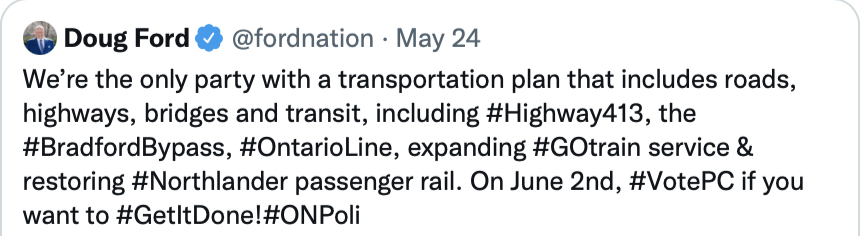
Markham's Regional Councillor Jim Jones told the Region's top transportation planner, Brian Titherington, at a meeting earlier this month which considered the final draft:
"This presentation is heavy on roads. What about rail? What's the strategy there?"
Lowering expectations
The Transportation Master Plan deliberately sets out to lower expectations on when we can expect to see an all-day two-way 15-minute fast rail service in Newmarket and East Gwillimbury.
East Gwillimbury’s population increased by a staggering 44.4% between 2016 and 2020 making it the fastest growing municipality in Canada. And this explosive growth is set to continue.
Only a fortnight ago, the Regional Council approved the release in East Gwillimbury of 1,730 acres (or 2.7 square miles) of so-called “Whitebelt” land for development.
Beat gridlock: build more highways
For the Ford Government the answer to gridlock is to build new highways and widen others. The Bradford bypass looks like a done deal but Highway 413 is subject to further review under the Federal Impact Assessment Act.
Billions are earmarked for highways that will fill up with traffic as soon as they are completed.
Yet decisions on road/rail grade separations - vital for an express train network - are left to the distant future.
Whether we get those grade separations - and the supporting analysis - is left to another day.
Road/rail grade separations
Last October the Acting Director of Transportation Services told members the draft TMP reduced:
“the number of road-rail grade separations to reflect the significant capital and operational costs”
But these road/rail separations are necessary if we are going to get a fast two way 15-minute service. Metrolinx says:
“Eliminating level crossings (where train tracks cross roads) will make the network better, faster and the region easier to travel in. There are two options when building a grade separation, tracks can either go under or over the road. By separating the road from the rails, vehicles can pass under (or over) a railway, without having to stop and wait for trains. Multiple grade separations are taking place across the network. Rail to rail grade separations are also needed, for much the same reason – to reduce traffic conflicts where train lines intersect.”
Silent on the 15 minute trains to Bradford
The TMP claims to be a long-term plan which identifies the infrastructure and initiatives that are needed to support population and employment growth to 2051 yet it is silent on key commitments made by Metrolinx last August to run an all-day two-way 15-minute service to Bradford, north of Newmarket.
If Bradford gets a 15-minute service then so do we in Newmarket.
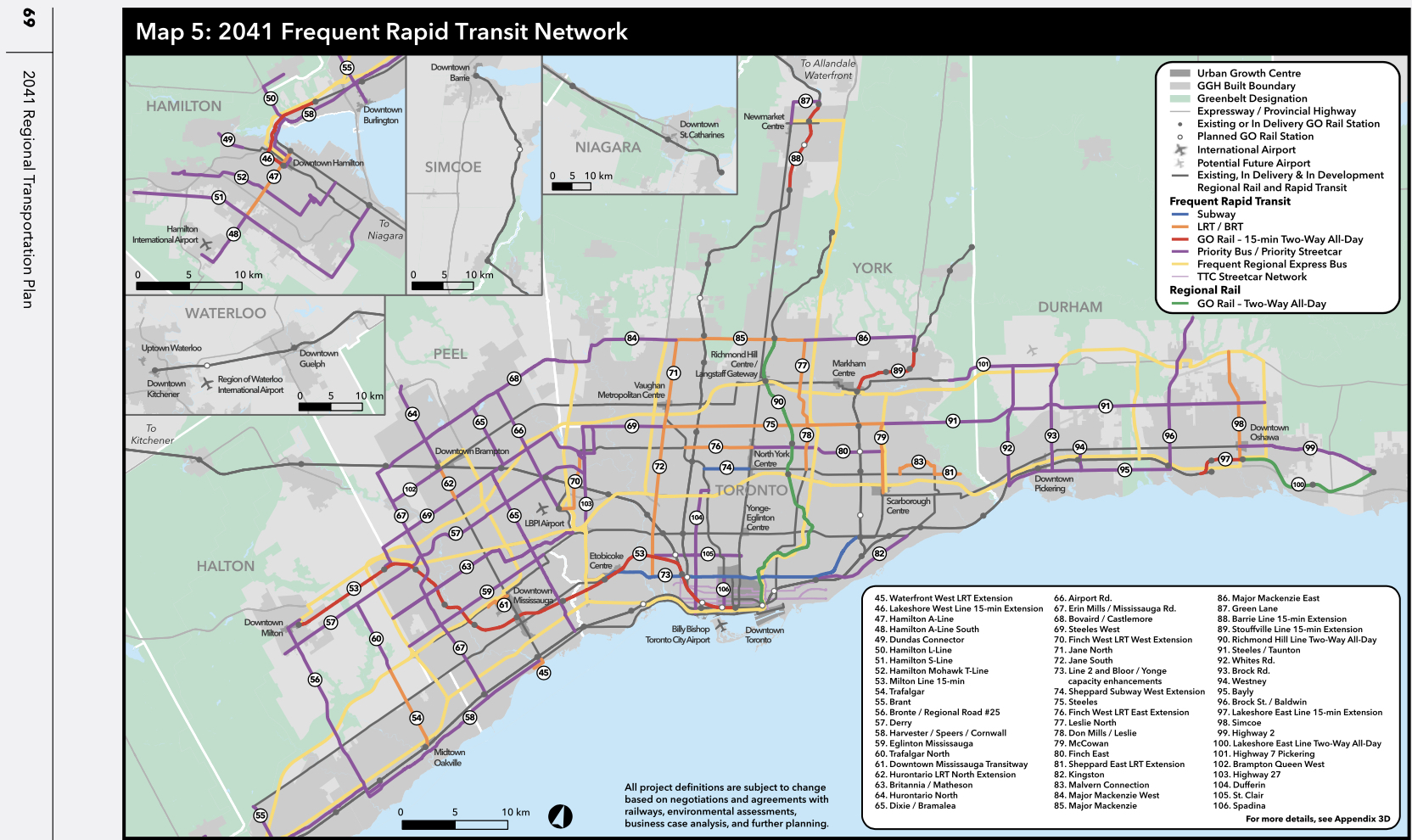
Instead, the Region’s Director of Transportation, Infrastructure Planning and Public Works, Brian Titherington, limply says the new TMP “aligns” with the Province’s transportation plan published in March this year and with the Metrolinx 2018 Plan which shows an all-day two-way 15-minute service running north from Aurora to Green Lane in 2041.
We can't wait until 2041.
Assumptions
The 15-minute commitment given by Metrolinx to East Gwillimbury Council ten months ago and repeated in numerous public statements since doesn’t rate a mention in the Transportation Master Plan.
We don't know what assumptions Metrolinx made when they told East Gwillimbury Council on 12 August 2021 that they could run a 15-minute service to Bradford:
“thanks to further study and optimisation of service plans”
Why hasn’t the Region’s Director of Transportation asked Metrolinx to provide more details for inclusion in York Region's TMP?
Subject to further study
The draft TMP presented to members of the Regional Council on 11 November 2021 didn't even show a grade separation at Davis Drive in 2051.
Newmarket Mayor, John Taylor, picked up on this and asked for a re-think. The TMP was revised to meet his concerns and the latest version shows possible road/rail grade separations at Mulock Drive, Davis Drive and Green Lane but these are “subject to further study”.
The Region and Metrolinx have been dancing around this issue for years. I've heard it all before.
A presentation on the future of the GO Rail station at the Tannery in Davis Drive in 2017 concluded that further studies were needed.
And here we are in 2022 and we are told yet again that further studies are needed. The can is always being kicked down the road, buying time.
Aligned with Province and Metrolinx
Titherington says the TMP is “aligned” with the plans put forward by the Province and Metrolinx
“while advocating for what York Region needs to support planned growth into the future from a transportation perspective”.
Don't believe it.
We have been consulted to death on this Transportation Master Plan and yet, mysteriously, despite this, it down plays the importance of rail transit.
All for the sake of "alignment".
The TMP will now be circulated to the Region's constituent municipalities and comes back to Regional Council in September for final approval and adoption.
Click "Read more" below the map to read Jim Jones's exchange with Brian Titherington.
Below: From the Metrolinx 2018 Plan showing the netwok in 2041: A fifteen minute service to Green Lane in East Gwillimbury.
Read more: York Region's Transportation Master Plan: "Heavy on roads. What about rail?"
- Details
- Written by: Gordon Prentice
Last Thursday, Newmarket Mayor John Taylor, voted against endorsing York Region's Official Plan (ROP) which guides development over the next 30 years.
An angry Taylor said he had never voted against a budget or an official plan at local or regional level in 16 years as an elected official. 
So this was a big deal.
Taylor warned his colleagues the Plan would encourage sprawl.
Regional Council ambushed with last-minute amendments
And he sharply criticized fellow members of York Regional Council for bringing large numbers of amendments forward at the last moment, precluding any detailed analysis or input from the regional staff.
“These significant amendments came forward largely with only a verbal explanation from a member of council. I cannot support this approach to planning. Some have even been brought back a second time to be expanded upon with still no written analysis. There are close to 20 employment land conversions not supported by staff and are largely unaccompanied by any analysis of any nature.”
Although Taylor was careful not to name anyone in particular it is clear he had Markham’s Mayor, Frank Scarpitti, and Vaughan's Maurizio Bevilacqua in his sights when he made the accusation.
Taylor believes the entire process has been subverted by the long list of pro-development eleventh-hour amendments to the plan.
Development will go to unserviced land, miles away from transit
Taylor told the meeting the Official Plan would open up 7,785 acres of land in the so-called Whitebelt for development. This land, which appears white in Growth Plan maps, lies between settlement areas and the Greenbelt and was seen as a reserve to accommodate growth in the long-term once existing settlements like Newmarket had been built-out with more intensive development.
The 7,785 acres identified by Taylor is about 12 square miles. The Town of Newmarket covers about 14.8 square miles. He told his colleagues they were choosing sprawl over intensification – and it was not sustainable, environmentally, socially or financially.
Taylor quoted a study in Ottawa which showed the costs of building infrastructure to service new developments in open country costs way more than within existing settlements. Taylor said the Hemson report showed:
“intensified forms of housing save a city about $600 per year, per unit. While new community housing or subdivisions cost the city around $450 per year per unit.”
Flawed
Taylor said the final version of the Regional Official Plan was too flawed to get his support.
Newmarket’s Deputy Mayor, Tom Vegh, who relies heavily on contributions from developers to fund his election campaigns, did not speak in the debate but voted to endorse the plan, complete with all the last-minute amendments.
The Regional Official Plan now goes to the Regional Council on 30 June 2022 for final approval.
Read Taylor's speech by clicking below.