Gordon Prentice at Large - Politics in Newmarket




- Details
- Written by: Gordon Prentice
It was a comment deliberately designed to make everyone sit up and pay attention.
When Doug Ford said out loud that Donald Trump can "kiss my ass" he knew it would (a) make headlines and (b) get a round of applause from Canadians totally fed up with the so-called "leader of the free world".
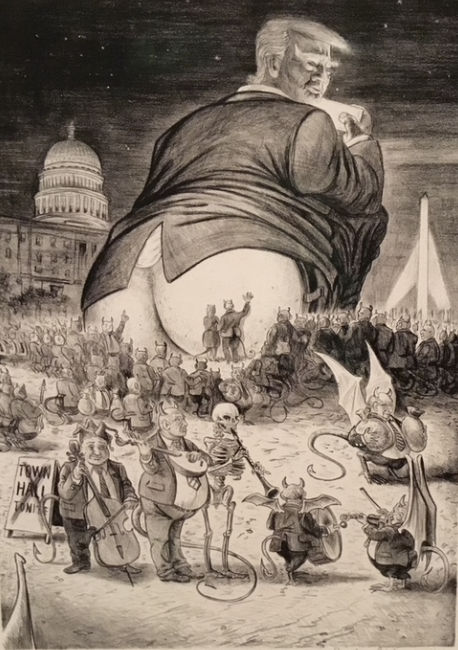
But in that moment Ford put an unwanted image in my head.
I was reminded of an exhibition on political satire at the Art Gallery of Ontario that I visited in 2019.
Back then, it was Trump's ass on display.
- Details
- Written by: Gordon Prentice
Nominations close at 2pm this Friday (21 August) for the elections to Newmarket Council on 26 October 2026. 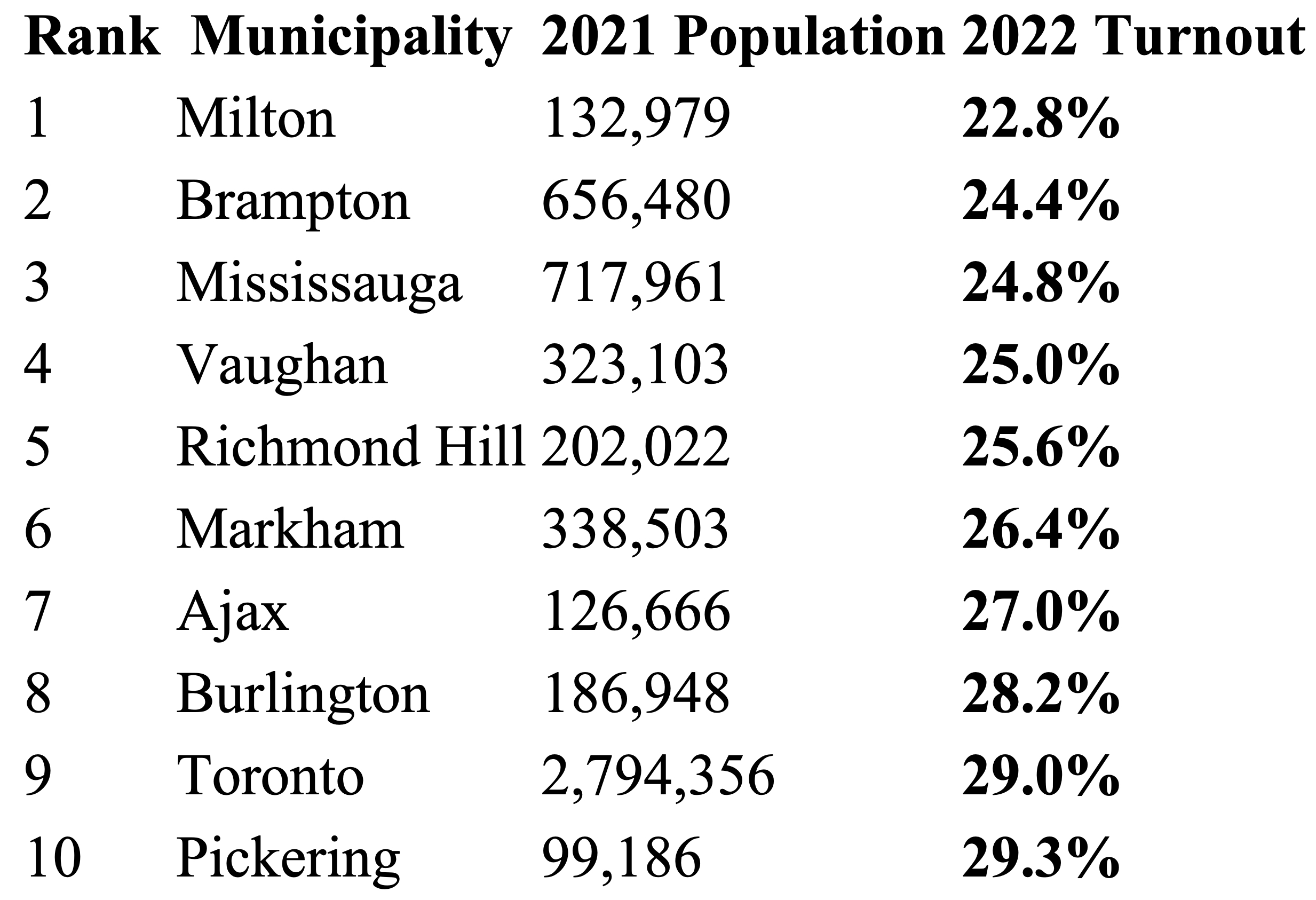
As I tap this out, there will be elections in five of the seven wards and for the Deputy Mayor. It looks like Mayor John Taylor, Bob Kwapis (Ward 5) and Christina Bisanz (Ward 7) will all be acclaimed and will be returned unopposed.
Why is there so little interest in municipal elections?
Pitiful turnout
At the last election in 2022, when I ran unsuccessfully against the incumbent Deputy Mayor Tom Vegh, the turnout was a pitiful 24.8%. But we were no worse than many others in Ontario.
The municipalities with populations over 50,000 that had the lowest voter turnout are shown in the table (right).
Where are the Political Parties?
Political parties are forbidden by Statute to contest municipal elections in Ontario. (But see note below.)
Of course, candidates don’t leave their politics at the door when they run for election to their local council and because they all run as “independents” it is difficult for the voters to get a handle on where they are coming from. Party colours and Party labels give voters an easy way to place candidates on the ideological spectrum.
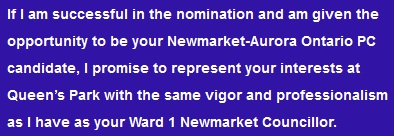
Newmarket’s Mayor John Taylor ran for the Liberals in the 2003 Provincial Election in York North against the PC incumbent Julia Munro and lost by 3,463 votes. Ward 7 councillor Christina Bisanz ran for the Liberals in Newmarket Aurora in 2007 narrowing losing by 1,355 to the incumbent PC MPP, Frank Klees. She ran again, unsuccessfully, in 2011. Ward 3 councillor Jane Twinney ran for the Progressive Conservatives in the 2014 Provincial Election and Tom Vegh tried to get into Queen’s Park as a Progressive Conservative but wasn’t selected as the Party's candidate. On 5 December 2016 Vegh told residents in Ward 1 that he was ready for a bigger challenge. (see graphic right)
Newmarket’s former Mayor, Tony Van Bynen, was forever droning on about being "steadfastly bi-partisan" but as soon as he retired he joined the Liberals and was selected from a shortlist of one and elected as the Liberal MP for Newmarket Aurora.
Institutional memory
At their best, Parties provide an institutional memory, recalling significant political events that most of us forget after a few weeks. They provide campaign finance and a ready-made band of volunteers to help in the campaign. (At their worst, they corruptly legitimise campaigns and elections that can be bought through signing up thousands of new Party members who are committed only to a particular candidate and not to the Party.)
Fighting an election as an independent costs money and for many excellent aspiring candidates this can be a real disincentive.
Election spending shouldn't be an Arms Race
In the 2022 Newmarket Election Tom Vegh spent $27,312 against my $7,292, a difference of $20,000 and approximately 3.75 times greater than my spend.
I took the view that running for election shouldn’t be an arms race and I did everything I could to minimise my spending – in retrospect a big mistake.
After the election I returned a surplus of $1,495 to the Town of Newmarket which was money I had raised for the campaign but did not spend.
Tough Call
As an “independent”, taking on an incumbent can be a tough call. He or she (the incumbent) has name recognition and four years to build support in the community – backed by the Town Hall machine. The Deputy Mayor, for example, has an Executive and Community Relations Assistant who
“reviews and analyzes social media channels, as well as Committee reports and decisions and alerting the Deputy Mayor on operational or emerging issues, and initiating the action required to respond.”
The assistant’s duties are wide ranging and include:
“monitoring activities related to social media channels and recommends options to improve social media content, outreach to the community and businesses, as well as support design elements that best serves the purposes of various audiences.”
This is from the Job Description:

Non-incumbents running for election do so, almost by definition, from a standing start.
So, how do candidates break through and get their message across to the voters?
Election Debates should be a key part of every election
Personally, I believe election debates are the great equaliser and they can break though into the public’s consciousness when reported by the local media.
In 2003, for example, when John Taylor ran against the PC incumbent, Julia Munro, the ERA newspaper reported that Taylor had put in a strong debate performance and this had narrowed the gap between the two in a Conservative leaning riding.
So, debates do matter.
Unfortunately, in 2022, neither the local Chamber of Commerce here in Newmarket nor the local media organised a debate for the contested Deputy Mayor position. For me, this was incredibly frustrating. You have no idea how much time and effort I put into trying to get a debate.
Three Choices
I gave Vegh three choices of dates with an offer that he could also select the debate moderator but he simply wasn’t interested. So I organised my own. The last thing he wanted to do was defend his disgraceful practice of taking money from developers to fund his election campaigns.
Over the years, I’ve stood in many elections in the UK and there has always been a candidates’ debate. Indeed, in my many years as an MP at Westminster, I used to do three or four across the constituency during each campaign.
Here in Newmarket the whole experience of running for election without a debate left me feeling profoundly dissatisfied. It was an election where, for me at least, there was still unfinished business.
I shall be blogging on these and other themes as the election campaign gets under way.
Correction on 18 August 2026: I said in my original post that Toronto was an exception to the rule that political parties could not contest elections at municipal level. The Ontario government confirmed in 2006 that the Municipal Elections Act did not prohibit candidates from working together or forming civic parties. This was reiterated during the 2016 legislative debate over municipal-election reform.
Civic parties may organize politically, but cannot obtain the formal electoral status, ballot designation and financial framework enjoyed by provincial and federal parties.
- Details
- Written by: Gordon Prentice
Will the real Dawn Gallagher Murphy stand up? 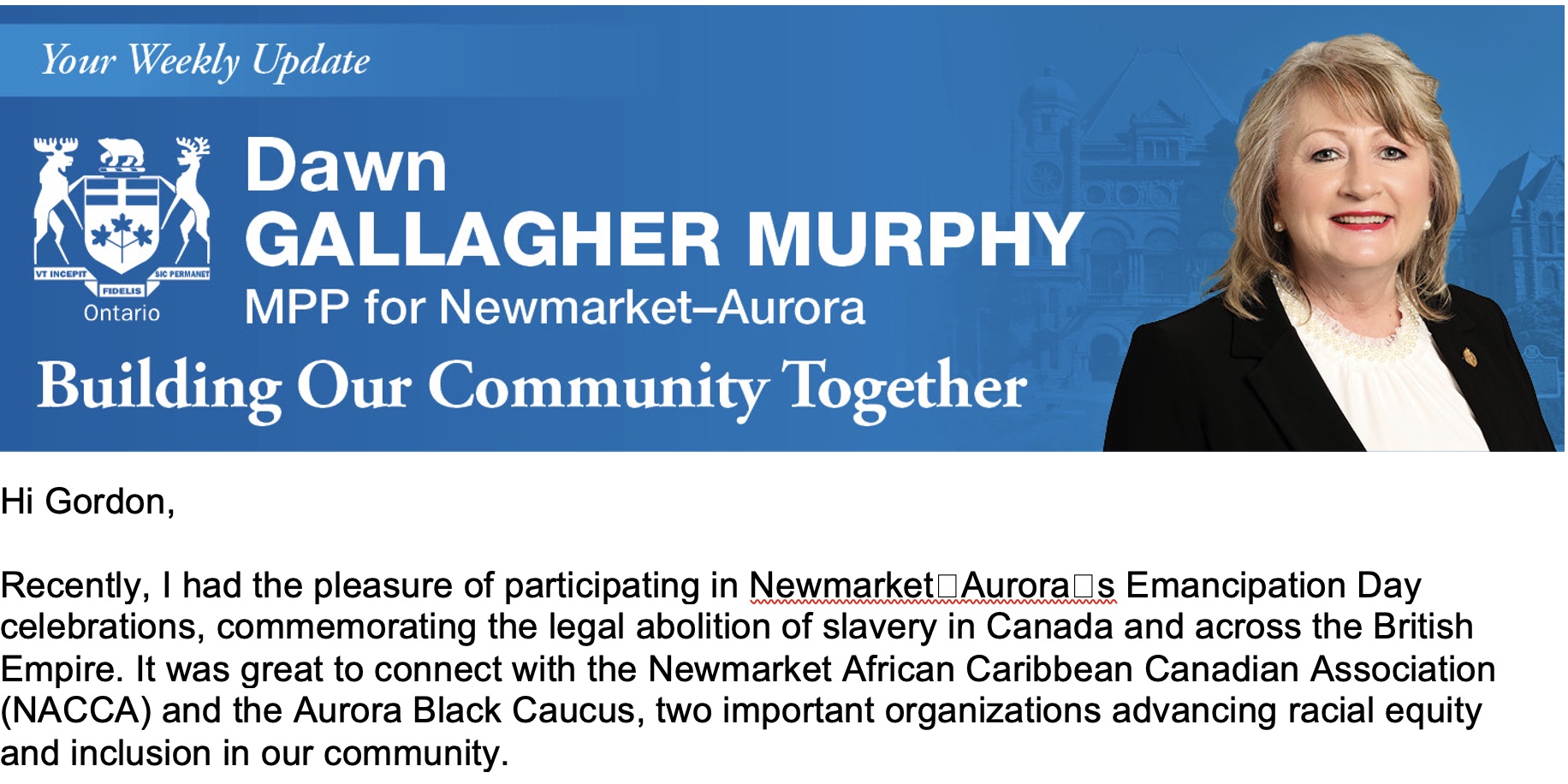
In her latest newsletter which arrived by email at 1pm today Dawn Gallagher Murphy says she had
"the pleasure of participating in Newmarket/Aurora’s Emancipation Day celebrations, commemorating the legal abolition of slavery in Canada and across the British Empire. It was great to connect with the Newmarket African Caribbean Canadian Association (NACCA) and the Aurora Black Caucus, two important organizations advancing racial equity and inclusion in our community."
Early last year, former members of her own staff called her out as a racist, alleging she referred to a Black History Month event as “woke bullshit”.
On 18 February 2025 Newmarket Today quoted a former employee:
“Ultimately, it was hard to go home and reconcile racist comments with my own personal beliefs. It was deeply upsetting.”
Newmarket Today reported:
"Allegations against Gallagher Murphy first surfaced in December (2024), when former constituency manager Teena Bogner filed a complaint at the Ontario Labour Relations Board, alleging Gallagher Murphy unfairly fired her after she raised concerns to PC Caucus Services about alleged harassment. That case was settled before the election campaign began, but a group of employees then came forward and hired a PR firm to share their own negative experiences working with Gallagher Murphy.
Those allegations include verbal abuse, calling and demanding work at unreasonable hours, lashing out, name-calling, not tolerating mistakes and reprimanding clothing choices in front of other employees."
Teena Bogner subsequently withdrew her complaint to the Ontario Labour Relations Board and settled with Gallagher Murphy before the hearing.
The details of the settlement have not been disclosed by either party.