Gordon Prentice at Large - Politics in Newmarket





- Details
- Written by: Gordon Prentice
It is surprisingly difficult to get information from Newmarket Public Library about its own operations. Just basic stuff such as the type of material being borrowed. 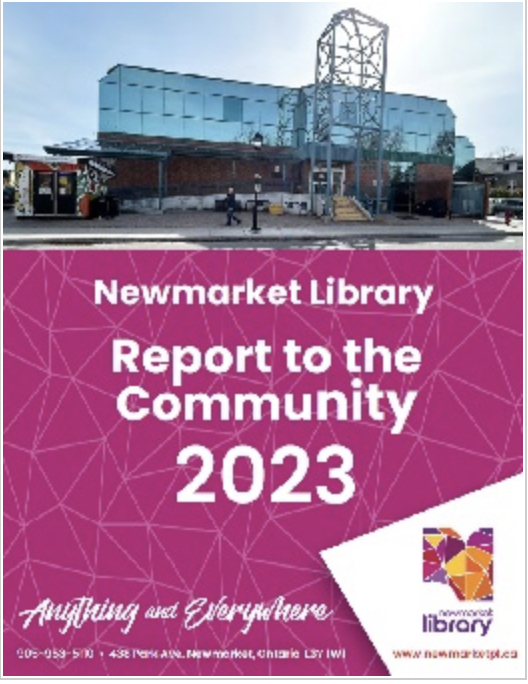
And this from an organisation whose Delphic new slogan promises: “Anything and Everywhere”.
For years I’ve believed the Library is simply too small and no longer fit for purpose. This was the firm view of the Library’s previous Chief Executive, Todd Kyle, who is now running Brampton’s eight libraries.
In our area Georgina and East Gwillimbury have three libraries each and Aurora and Whitchurch-Stouffville have a single library like Newmarket but with much smaller populations.
The current library board is not pressing for a new library – or, indeed, an additional branch – and one of its members, Councillor Victor Woodhouse, ridicules the very idea.
And although some members of the Town Council in the past have either championed a new library or have been sympathetic, these days are long gone. The Council decided early in its current term that a new library was not a “strategic priority”.
Who uses the Library?
But the one question that won’t go away is this: who uses the library? Is the building in Park Avenue essentially a neighbourhood library for Ward 5 and the Downtown or are its members and users spread across Newmarket?
When the Library Chief Executive, Tracy Munusami, presented her “Report to the Community 2023” to the Town Council on 8 April this year, Ward 7 councillor Christina Bisanz asked her if she tracked where people visiting the library and have library cards actually live. This might give:
“some indication of where there’s an opportunity to raise even more awareness of not only the physical library itself but the different services you provide.”
The Chief Executive said she looked at the ward split for library cards in 2022:
“And there were some wards that did have more library card users than others and so we’ve used that data to try to target where our outreaches are in the community.”
She told councillors she hadn’t done a follow-up since then but she could find out.
I’m waiting.
Perhaps the Library Board when it meets this Wednesday (18 September 2024) can ask for this basic information and share it with the Mayor and Council and public.
Statistics
For over a decade, a full range of statistics was routinely reported to the Library Board which allowed for meaningful comparisons to be made year over year. This is no longer the case. The 2023 statistics, for example, don’t even give the total number of Newmarket Library card holders.
I asked the Town for sight of the full range of statistics for 2023 – beyond those selectively highlighted in the “Report to the Community 2023”. I was told these were not available:
“Unfortunately, the requested statistics cannot be provided. Statistics such as renewed members and number of cardholders must be pulled in real-time, and no 2023 data is available. Due to changes in the software used for booking programming we cannot provide detailed breakdowns of program and program attendance only aggregates. Circulation statistics cannot be provided in detail in the same categories as there was a cataloguing error resulting in missing data when broken down into categories.”
Back in April, the Mayor John Taylor told Tracy Munusami there was a lot of interest in Library data and he wanted her to share “some of the good news story”.
Telling us the number of Library members by Newmarket Ward would be a good start.
- Details
- Written by: Gordon Prentice
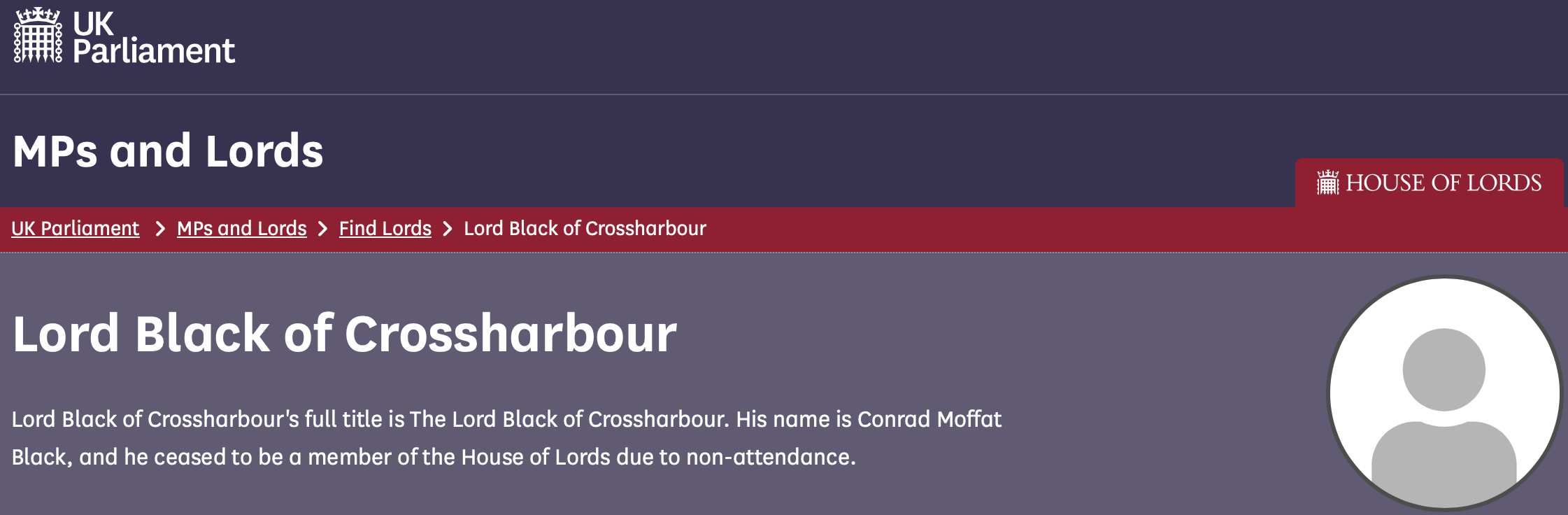
I laughed out loud when I read that yesterday Conrad Black, aka Lord Black of Crossharbour, had been expelled from the House of Lords for non-attendance. 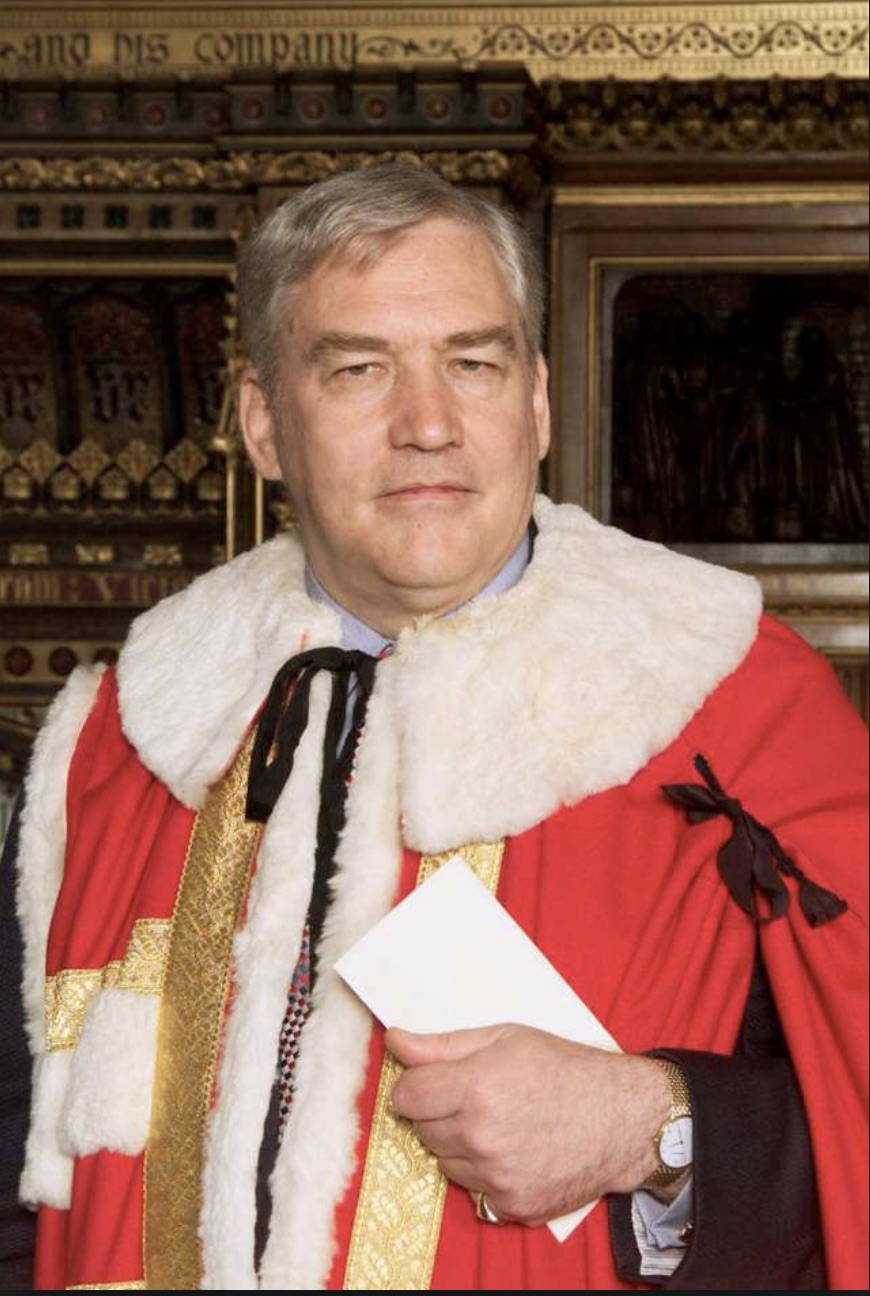
I’ve been blogging on-and-off for years about the convicted fraudster Conrad Black, well before he threatened to sue me for defamation.
Unaware
Black told the CBC he was unaware that his membership of the Lords had been terminated. He said it didn't really matter to him but he was surprised he wasn't notified first.
For years Black hasn't been remotely interested in what was happening in the UK Parliament - nor in keeping up with the evolving rules governing its membership.
Yesterday morning peers were told that Lord Black had ceased to be a member
"pursuant to Section 2 of the House of Lords Reform Act 2014, by virtue of non-attendance in the last Session"
Planning to return
After he was released from prison in Florida he told the BBC in 2019 that he planned to return to the Lords but it didn’t happen.
It may have been something to do with his opaque tax status. I don’t know.
I have long been interested in his tax affairs. After the Ashcroft scandal in early 2010 the UK Parliament passed the Constitutional Reform and Governance Act which obliged all members of the UK Parliament to pay UK tax.
Unlike members of the House of Commons who, as a matter of practical politics, have to live in the UK, peers can live absolutely anywhere. Even, dare I say, in Canada.
Tax status
Years ago I pressed the House of Lords authorities to ask all peers if they paid UK tax. They refused to do so. In the genteel and trusting world of the House of Lords that was a step too far.
But they did say they would remind all peers of their obligation under the 2010 Act to pay UK tax.
Conrad Black wouldn't have liked that.
My Freedom of Information requests to HMRC and the CRA about Lord Black’s tax status predictably ran into the sands of taxpayer confidentiality and got nowhere. I found it impossible to establish if all members of the UK Parliament complied with the requirement to pay UK tax.
"Fully qualified"
In 2021 I asked Black if he satisfied the requirements for membership of the UK Parliament or if he was there under false pretences he told me:
“Of course I am fully qualified to hold the status I do.”
Black, the convicted fraudster, is inviting us to take that on trust. (I don't.)
Black will, of course, keep his honorific title though I doubt he will use it here in Canada.
But I suspect he will still be Lord Black when he books a restaurant table in London.
- Details
- Written by: Gordon Prentice
Tomorrow’s UK General Election (4 July 2024) will see Britain’s ruling Conservative Party obliterated after 14 years in power. 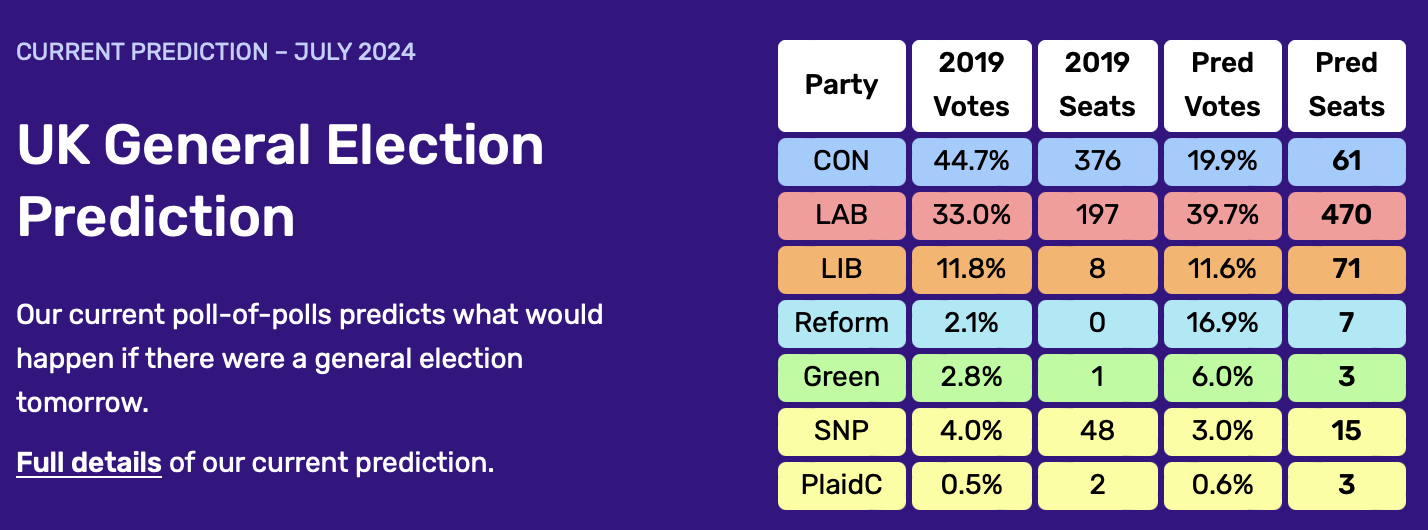
The Opposition Labour Party will win a huge majority though pollsters disagree on its scale. But we all know the tectonic plates are shifting and the political landscape will be very different on 5 July when the votes are counted.
The election prediction website, Electoral Calculus, gives the Conservatives 61 seats in the new House of Commons trailing the Liberal Democrats who are on 71. So Rishi Sunak – assuming he holds his traditionally ultra-safe seat of Richmond and Northallerton - may not even be the Leader of the Opposition.
How on earth did it come to this?
Today’s New York Times tells its readers
“The Conservative party has dramatically reshaped Britain since 2010, orchestrating its exit from the European union, slashing spending on public services and cutting welfare spending. Time and again, British voters have returned the party to power. But Britons say their country is worse off now than when the Conservatives took office.”
Very true.
But there's more to it than that. The rot is everywhere.
D Day
We witnessed Rishi Sunak's terrible misjudgement, leaving the D Day Commemorations early - so that he could get back to the UK for a political interview.
And in the middle of the election campaign we learn some very important people in Sunak's immediate circle had bet on the most likely election date.
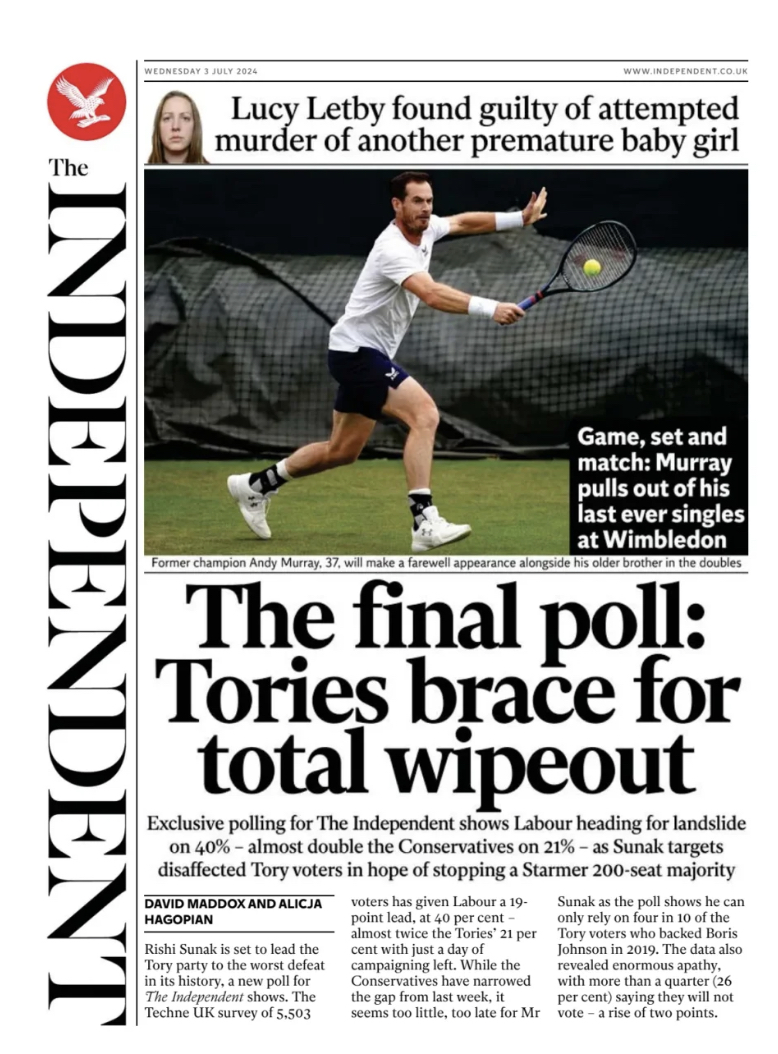
The police are now involved.
Britain has seen a merry-go-round of five Prime Ministers in less than a decade. One of whom, Boris Johnson, was found to have deliberately lied to MPs. In our Parliamentary system in Canada, as in the UK, this is the ultimate hanging offence.
The Canadian Parallel
In Canada’s Federal Election in 1993 the newly installed Prime Minister, Kim Campbell, lost her riding in Vancouver Centre and saw her Progressive Conservative Party wiped out, reduced to two seats. The Bloc Québécois became the Official Opposition.
In his 2005 book “The Secret Mulroney Tapes” Peter Newman says the election was a plebiscite on Brian Mulroney whose 3,202 days as Canada’s Prime Minister ended on 24 June 1993, roiled by scandal and disaffection.
“The historic Party, which in its various guises had founded the country and fielded twelve Prime Ministers who had governed Canada for more than half a century, was eliminated from contention.”
Throwing in the towel
In Britain, the Conservatives make no pretence that they can win tomorrow’s election. It is all about limiting the damage that a Labour “super majority” would inflict on the country. They say a bad result could cement Labour in power for a generation. People simply don’t believe that sort of nonsense.
For long enough the Conservatives had no other parties competing against them for votes on the right.
The so-called progressive vote was too often split between Labour and the Lib Dems allowing the Conservatives to slip through the middle – like Doug Ford’s Ontario PCs - often with well under 50% of the vote.
Reform UK
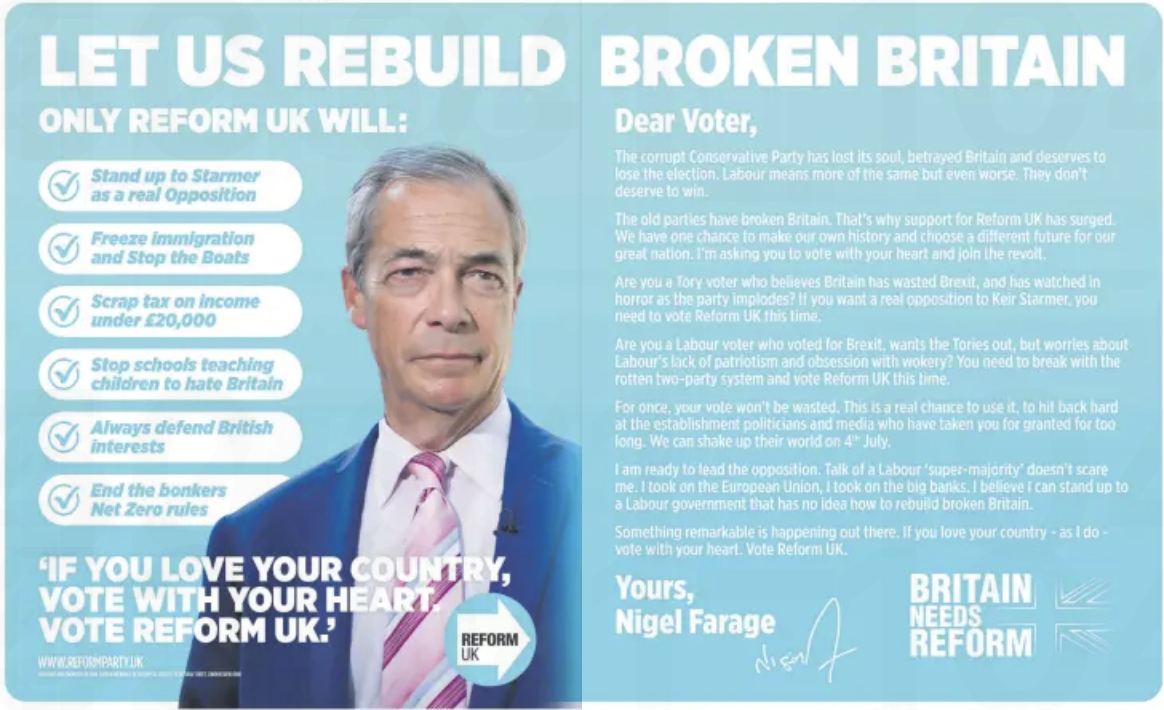
Tomorrow’s election signals the arrival of Nigel Farage’s insurgent Reform UK Party which will take a huge bite out of the Conservative vote although it is uncertain how this will translate into seats because of the vagaries of first-past-the-post.
Farage has been bearding the lion in its den, taking his populist message to the readers of the Daily Mail, telling them it’s time to ditch the Conservatives. (see below)
His message seems to be resonating in true blue Skipton and Ripon – Conservative for as long as I can remember and only a few miles from where I used to live. Unbelieveably, there is a 66% chance of Reform UK winning there.
The kaleidescope is turning. We wait to see where the pieces fall.